Earthquake swarm far north of Kolbeinsey Island

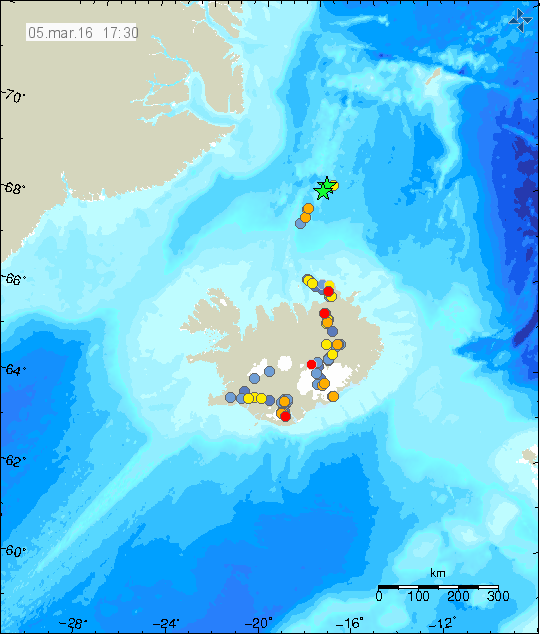
Today (5-March-2016) an earthquake swarm place took place around 190 km north of Kolbeinsey Island. Two largest earthquakes detected had the magnitude of 3,3. Other earthquakes where smaller in magnitude. Due to distance exact location is difficult to confirm, along with exact magnitude. This earthquake activity did not appear on EMSC seismic network.

160305_1730
Green stars show the location of this activity. Its only a best estimate by Icelandic Met Office. Copyright of this image belongs to Icelandic Met Office.

At this location there might be a volcano, it is unconfirmed at the moment. Last eruption is suspected to have taken place between 1997 or 1998. This volcano doesn’t have any name that I know of.

Earthquake swarm in Bárðarbunga volcano (Week 09)

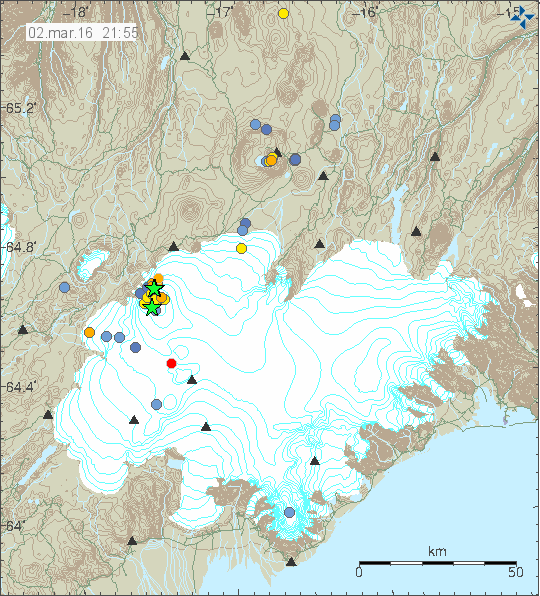
Bárðarbunga volcano continues it earthquake activity and it has now been a year since the eruption in Bárðarbunga volcano ended in Holuhraun (article I wrote about it can be found here). This activity (image) took place on 2-March-2016.

160302_2155
The earthquake activity in Bárðarbunga volcano. Green stars are earthquake with magnitude above 3,0. Copyright of this image belongs to Iceland Met Office.

Largest earthquakes in this swarm had the magnitude of 3,1, 3,3 and 3,6. Other earthquakes where smaller in magnitude. The reason for this earthquake swarm seems to be a developing weakness in the north and western part of the caldera. Activity in south part of the caldera seems to be crust adjustment to this weakness (stress changes). The weakest area is long one (I didn’t find information on how large the caldera is, but it is large). This weakness is going to continue to develop until an eruption happens or the magma finds it self a new path and that is more likely than an eruption taking place in the caldera rim, however I cannot rule out an eruption in the caldera at this point. This is all just wait and see situation at the moment. Interesting earthquake also took place in Hamarinn volcano, it had the depth of 13 km and magnitude of 0,7.

Deep earthquakes also took place in Tungnafellsjökull volcano. That earthquake had the magnitude of 0,8 but depth of 17,9 km. Suggesting that some stress changes at depth are taking place. In this case I doubt magma created the earthquake.

If an ash eruptions takes place in Bárðarbunga volcano, the resulting ash fall would be devastating (besides the following glacier flood). Last time larger eruption took place in 1477 half of Iceland got covered in volcano ash (that’s 50% of land), the volcano ash eruption in 1711 covered north Iceland and large parts of east Iceland. In 1711 to 1729 total of nine glacier floods took place and the source of them is believed to be Bárðarbunga volcano. Glacier floods from other volcanoes (Grímsfjall, Kverkfjöll, Þórðarhyrna, Hamarinn) are also highly dangerous. The volcano ash had thickness up to 100 meters next to the eruption area in 1477 (see map in link 1).

Source 1: Hvaða tjón gæti mögulega hlotist af gosi í Bárðarbungu? (Icelandic)
Source 2: Hvað eru mörg gos þekkt í Bárðarbungu og hefur orðið mikið tjón af þeim? (has gravity map of Vatnajökull glacier, Icelandic)

Short overview of earthquake activity in Iceland

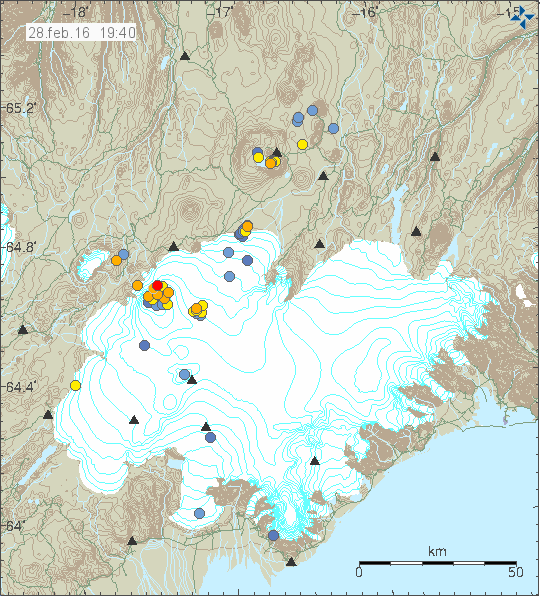
This is a short update of earthquake activity in Iceland on 28-February-2016.

Bárðarbunga volcano

Over the past 48 hours there has been earthquake activity and dyke activity in Bárðarbunga volcano. Some of this earthquake activity has been on around 15km depth. Suggesting magma movements within Bárðarbunga volcano system. Earthquake activity always seems to increase few hours to days after a swarm of deep earthquakes appear in Bárðarbunga volcano.

A dyke activity has appeared on the edge of Bárðarbunga volcano, it is located south-east in the volcano. In a area that has seen this type of dyke activity before. It is interesting that this activity seems to persist at this location.

Tungnafellsjökull volcano

Over the past few days few earthquakes have appeared in Tungnafellsjökull volcano. Some of those earthquakes have had the depth around 15 km. This suggest some type of magma movements inside the volcano, but nothing that suggests that its going to reach the surface any time soon.

Askja volcano

Earlier this week (Week 08) an deep earthquake swarm took place in Askja volcano. With earthquakes having the depth down to around 22 km. Suggesting that magma is flowing into Askja volcano magma chamber at depth. This has been happening at regular basis since 2010. At the moment there is nothing suggesting that eruption is going to happen any time soon in Askja volcano.

160228_1940
Earthquake activity in Bárðarbunga, Tungnafellsjökull and Askja volcano. Copyright of this image belongs to Iceland Met Office.

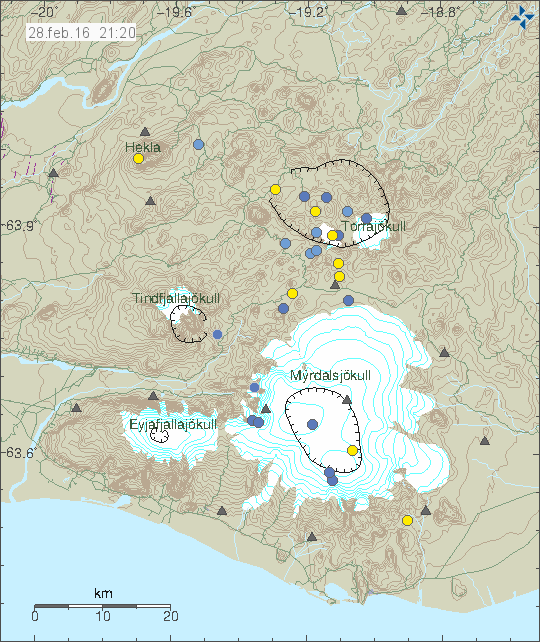
Katla volcano

There was some minor earthquake activity in Goðabunga in Katla volcano. This appears to be normal activity for this region of Katla volcano. No other interesting activity took place this week (Week 08) in Katla volcano.

Hekla volcano

Two earthquake where detected in Hekla volcano. Nothing else happened following this earthquake activity. Why this earthquake activity happens remains unclear.

Torfajökull volcano

A minor earthquake activity took place in Torfajökull volcano during the weekend. This activity is possibly due to changes in hyrdrothermal areas in Torfajökull volcano.

160228_2120
Earthquake activity in Katla, Torfajökull and Hekla volcano. Copyright of this image belongs to Iceland Met Office.

Other than this activity things remain quiet in Iceland. There are few minor earthquake swarms on Reykjanes peninsula and Tjörnes Fracture Zone. But they are too small at the moment to write about.

Donations

Please remember to support me with donations. The new computer left a big hole in my budget and any support in order to cover it are welcomed. Thanks for the support. 🙂

Move to Denmark

It is now official. I’m moving back to Denmark on 14. April, with just few minor details left to work out (getting a loan for the apartment insurance and few other things). I’ll move into my new apartment on the 15th April. More details later next weeks when I know about the apartment loan.

Earthquake swarm in Bárðarbunga volcano (Week 06/2016 #2)

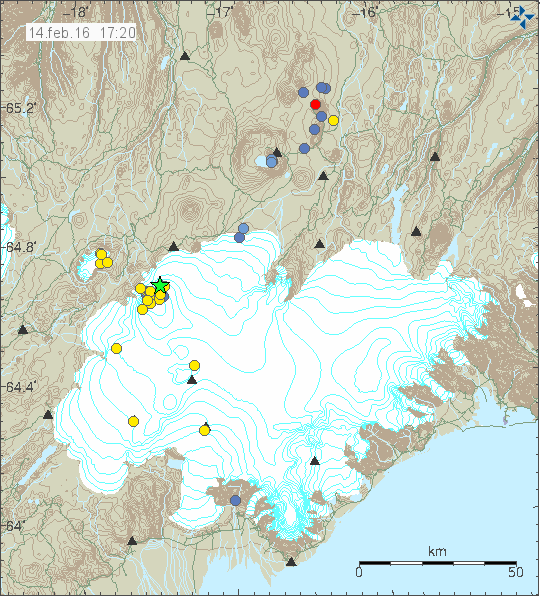
On Saturday 13-February-2016 at 19:32 UTC an magnitude 3,6 earthquake took place in Bárðarbunga volcano. Depth of this earthquake is registered 1,1 km. Swarm of smaller earthquakes followed the main earthquake, deepest earthquakes had the depth around 12 km.

160214_1720
The earthquake swarm in Bárðarbunga volcano. Copyright of this image belongs to Iceland Met Office.

Tungafellsjökull volcano

On Sunday 14-February-2016 an earthquake swarm started in Tungafellsjökull volcano. It’s still not known what is creating the earthquake activity in Tungnafellsjökull volcano. The most popular idea (among geologists) is that stress changes from Bárðarbunga volcano is resulting in earthquake activity in Tungafellsjökull volcano. I don’t know if that is true or not, since earthquake activity in Tungafellsjökull volcano started several years before the eruption in Bárðarbunga volcano in August-2014.

Donations

Please remember to support my work with donations or by using the Amazon banners I have up here and under Amazon Store banner. Thanks for the support.

Minor earthquake swarm on the Reykjanes peninsula

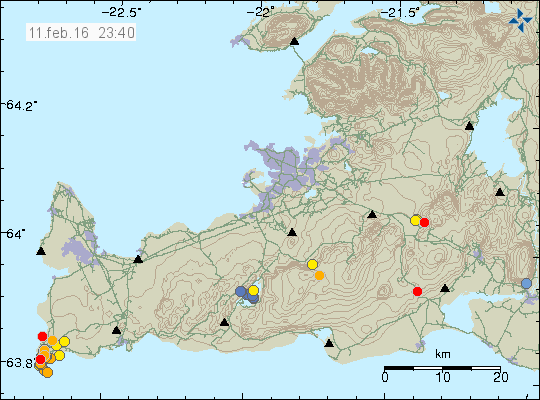
Yesterday (11-February-2016) at 08:47 UTC an earthquake swarm started on the Reykjanes peninsula. This has so far been a small earthquake swarm and largest earthquake so far had the magnitude of 2,7 other earthquakes have been smaller in magnitude.

160211_2340
The earthquake swarm on the Reykjanes peninsula. This is at the moment a small earthquake swarm. Copyright of this image belongs to Iceland Met Office.

This is classic earthquake swarm pattern on the Reykjanes peninsula at the moment. It does appear that this earthquake swarm is over, but it might start again without warning. This earthquake swarm is not connected to a volcano activity in the area, but it is forming a rift valley in the area.

Article updated at 00:53 UTC.

Magnitude 3,1 earthquake in Tjörnes fracture Zone (TFZ)

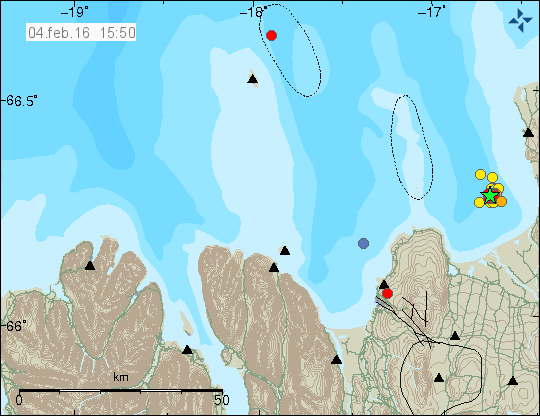
Today (04-February-2016) an magnitude 3,1 earthquake took place in south Tjörnes Fracture Zone. I don’t know if this earthquake was felt in nearby village of Kópasker.

160204_1550
The earthquake swarm on Tjörnes Fracture Zone, the green star is the magnitude 3,1 earthquake. Copyright of this image belongs to Iceland Met Office.

This earthquake swarm has now been going on for almost a month now and there doesn’t seems to be any sign of this earthquake swarm stopping any time soon. The activity drops at times, but always continues, even at low levels. Activity did increase after the magnitude 3,1 earthquake, but it has since dropped again into the same low it was before. I do expect this earthquake activity to continue.

Magnitude 3,9 earthquake in Reykjanes peninsula

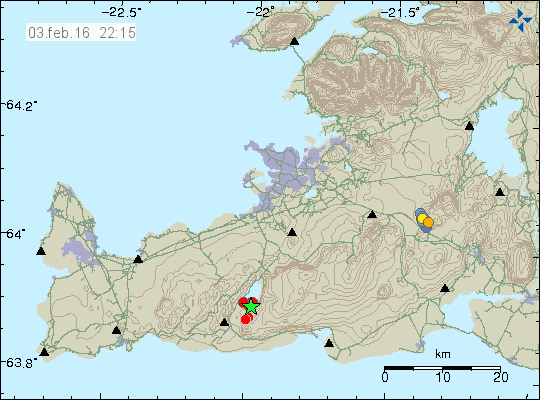
Tonight at 19:50 UTC a magnitude 3,9 earthquake took place in Krýsuvík volcano. This earthquake is not volcano related, this is a tectonic earthquake and has started a minor earthquake swarm in Krýsuvík area. Other earthquakes so far have been small, with largest aftershock having the magnitude of 1,6. The magnitude 3,9 earthquake was felt in Hafnarfjörður and in the Reykjavík area (and nearby towns).

160203_2215
The earthquake activity in Krýsuvík volcano tonight. Copyright of this image belongs to Iceland Met Office.

This earthquake swarm is currently ongoing, but it doesn’t appear to be a strong or a highly active earthquake swarm at the moment. It’s unclear if that is going to change since it’s impossible to predict how this earthquake swarms behave.

Update 3 on Tjörnes Fracture Zone earthquake swarm

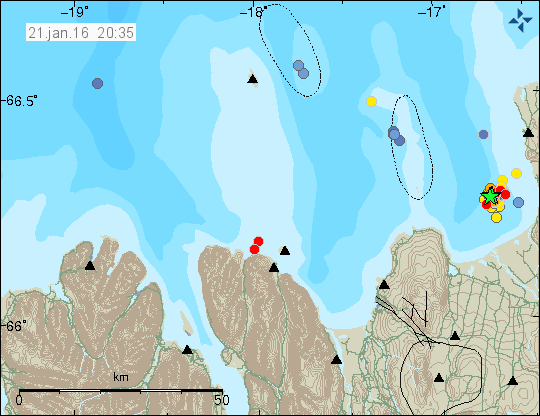
Today (21-January-2016) the earthquake swarm on Tjörnes Fracture Zone continued after a little stop. This time it was the earthquake swarm on the south end (next to Kópasker village) that started to increase. The change happened around 02:30 UTC this morning and in the beginning a magnitude 3,1 and 3,6 earthquake took place. Total of three earthquakes took place with magnitude 3,0 or larger. The earthquake swarm was most active until around 06:00 UTC when it started to slow down. The earthquake swarm continues at this moment, but it appears to be slowing down. The largest earthquake was felt in Kópasker.

160121_2035
The earthquake swarm on the south end of Tjörnes Fracture Zone. Copyright of this image belongs to Iceland Met Office.

Earthquake swarms in this area of TFZ are common and often there are several taking place over the year. I expect this earthquake swarm to continue for next few days. The risk of more magnitude 3,0 or stronger remains high. It is also a question if this activity starts earthquake swarm on nearby faults on TFZ. This activity is not connected to any volcano, this only tectonic earthquakes due to stress related changes (continental drift) in the area.

If any new development happens. I’m going to update this article.

Donations

Please remember to support my work with donations or by using Amazon. Thanks for the support. 🙂

Website

I’ve been doing few changes to this website. It’s now possible to see latest comments posted. That can be found above the calendar. Now it’s also possible to go directly to my webicorder (geophones) website if anything happens when it comes to earthquakes.

Earthquake swarm in Bárðarbunga volcano (Week 03/2016)

Today (20-January-2016) at 13:05 UTC an earthquake swarm started in Bárðarbunga volcano. This earthquake swarm was not a surprise to me, since I had seen clues it would happen on 17 and 18 of January-2016 (more details later in this article). I wasn’t sure if it would happen.
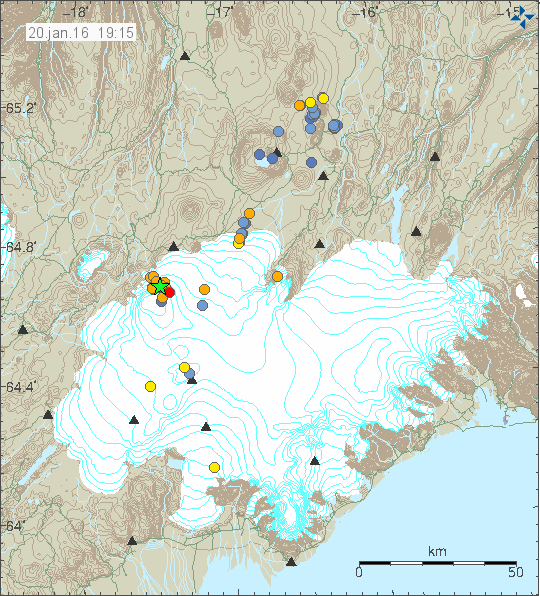
160120_1915
The earthquake swarm in Bárðarbunga volcano today. Copyright of this image belongs to Iceland Met Office.

The largest earthquake in this swarm had the magnitude of 3,6 and that is a increase in magnitude from last earthquake swarm taking place at this location two weeks ago. This earthquake appears to have been created by a magma breaking rock under pressure (low frequency element present in it).
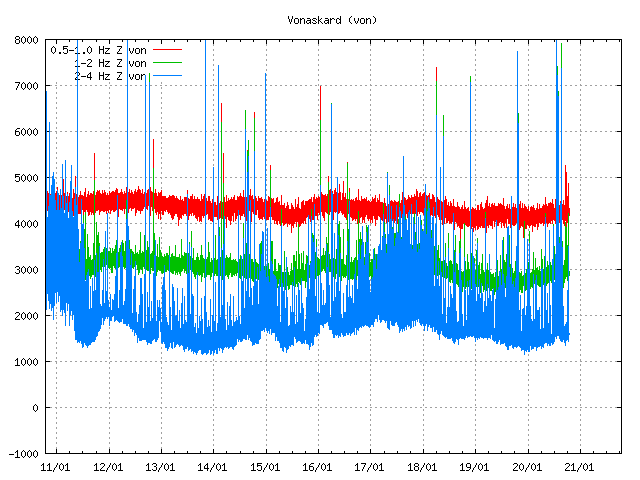
von.svd.20.01.2016.at.19.04.utc
The harmonic tremor plot from Vonarskarð SIL station, next to Bárðarbunga volcano. Copyright of this image belongs to Iceland Met Office.

I have noticed and I told Icelandic Met Office about this few days ago. There is a change in the harmonic tremor plot at 2-4Hz few days before an earthquake swarm starts in Bárðarbunga volcano. This has happened several times. Last time this happened is on 17 and 18 January-2016. Why this happens I don’t know for sure. One idea is that magma is over-pressuring once it enters the magma chamber and this might be gas release in the magma at the same time. If that is the reality, it is creating a magma foam at the top of the magma chamber that would erupt rather explosively when the pressure breaks the magma chamber currently holding it (see here, I’m not sure what this is called in science). This is only a idea that I have, but I find it the most likely explanation on what is going on in Bárðarbunga volcano. This might be wrong, but only time is going to tell what happens in Bárðarbunga volcano.

The time period between earthquake swarms is getting slightly shorter, now it’s around half a week from a whole week as was last month (December-2015). This change of phase suggests that more magma is flowing into the magma chamber and possibly in greater volume. The path the magma flows into the magma chamber is clear of all blockage, that means no earthquakes are created at that location. Current evidence suggest that only one magma chamber is being filled up with magma at the moment, but that magma chamber might be big and with some room left, but that might be quickly running out as is suggested by current earthquake swarms. The earthquake activity would be considerably higher if an eruption was about to start.

If anything more happens in Bárðarbunga volcano this week I’m going to update this article. Unless an eruption starts, then I’ll write a new one.

Update 1

A minor dyke intrusion took place in Bárðarbunga volcano caldera today (21-January-2016). The strongest earthquake in this dyke intrusion had the magnitude of 2,8 and depth of 2,5 km. This was a small and short event that took place.
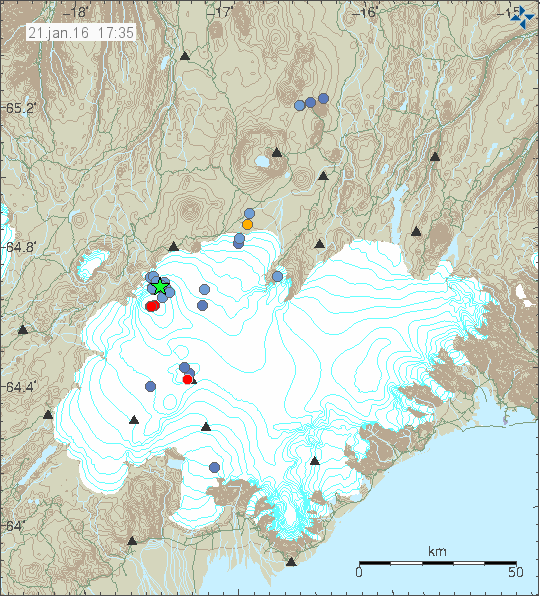
160121_1735
The dyke intrusion in Bárðarbunga volcano took place in SW part of the caldera. Copyright of this image belongs to Iceland Met Office.

It’s difficult to know for sure what this means. What is clear is that magma is trying to break a path to the surface and it might have found a weak spot in the crust inside the caldera. If this starts to be a regular feature it means problems. This is the second weak spot to form in the caldera, the first one being in North-east part of the caldera, creating weekly earthquakes since September-2015.

Article updated at 01:52 UTC on 21-January-2016. Error fixed in date (it was not 10 and 11, it was 17 and 18th of January-2016).
Article updated at 20:56 UTC on 21-January-2016.
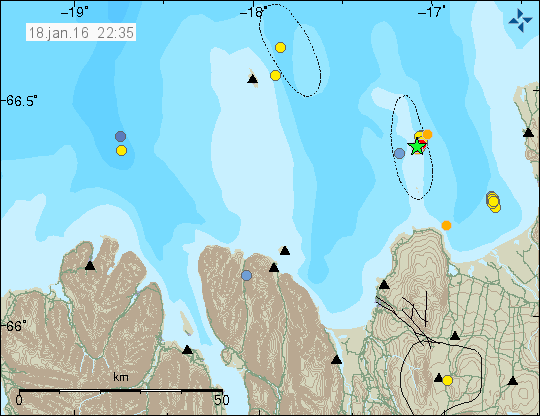
Update 2 on the earthquake swarm on Tjörnes Fracture Zone

The earthquake swarm on Tjörnes Fracture Zone (TFZ) that started on 12-Januar-2016 continues. The earthquake swarm is now smaller then in last few days, largest earthquake in past 48 hours had the magnitude of 3,3 with the depth of 17,8 km. Number of earthquakes in the last 48 hours is only 53 at the moment.

160118_2235
The earthquake swarm in TFZ for the past 48 hours. Copyright of this image belongs to Iceland Met Office.

It is difficult to know for how long this earthquake swarm is going to continue in Tjörnes Fracture Zone. This earthquake swarm might continue for next few days at most. It remains a question if new earthquake activity is going to start in Tjörnes Fracture Zone, that sometimes happens, but not always.