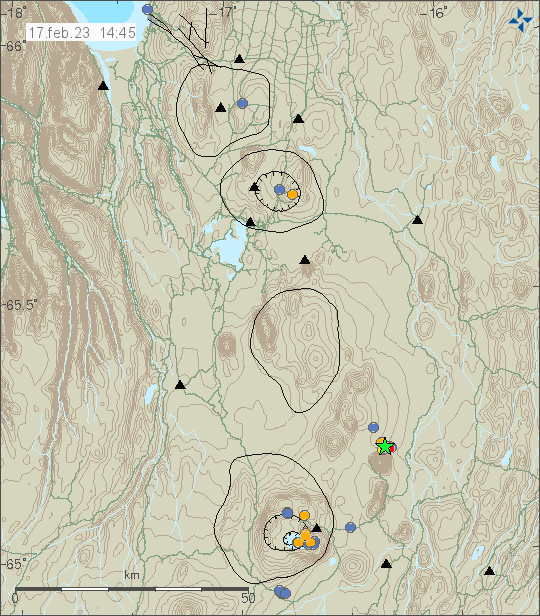
Today (17. February 2023) at 09:26 UTC an earthquake with magnitude of Mw3,5 took place around 4 km north of Herðubreið mountain. This earthquake seems to have started an earthquake swarm in that area. It is unclear if this earthquake activity is connected to inflation that is taking place in Askja volcano.
Earthquake activity in Herðubreið mountain. Copyright of this image belongs to Icelandic Met Office.
There has been increase in earthquake activity at this location in Herðubreið mountain, but why is unclear.
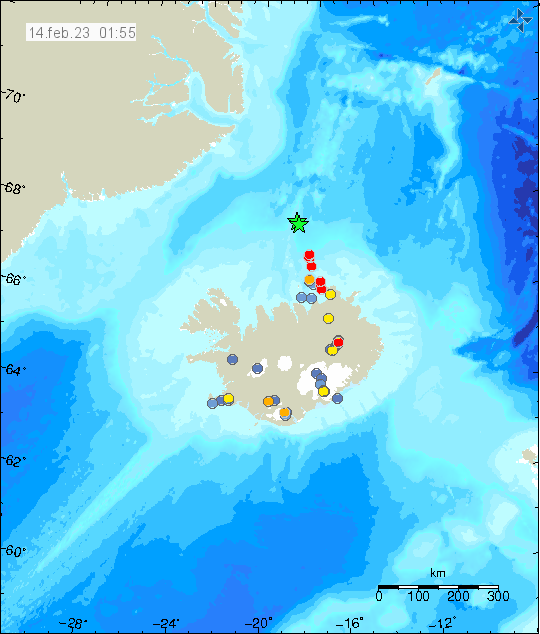
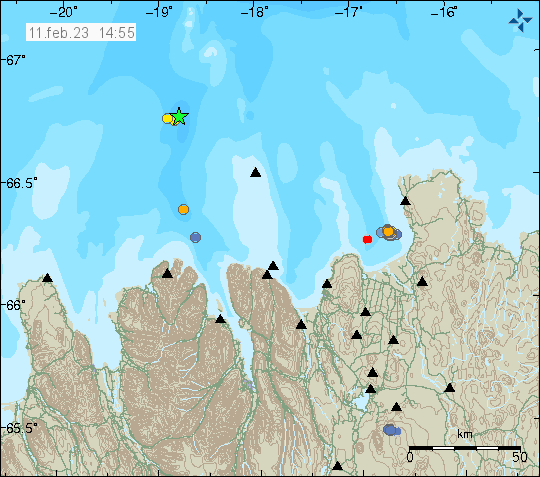
Today (14. February 2023) at 01:24 UTC an earthquake swarm started around 70 to 90 km north of Kolbeinsey island. It might be in Kolbeinsey island. Largest earthquakes recorded at the writing of this article had a magnitude of Mw3,5 according to Icelandic Met Office. EMSC is reporting two earthquakes with magnitude of mb4,5 at the writing of this article.
Earthquake activity north of Kolbeinsey island. Copyright of this image belongs to Icelandic Met Office.
Distance from land makes it difficult for the SIL network that Icelandic Met Office runs to detect the smallest earthquakes. This means there can be a lot more going on that appears on earthquake maps. There’s always a chance of stronger earthquakes in this area north of Iceland.
Update Update at 16:50 UTC on 14. February 2023
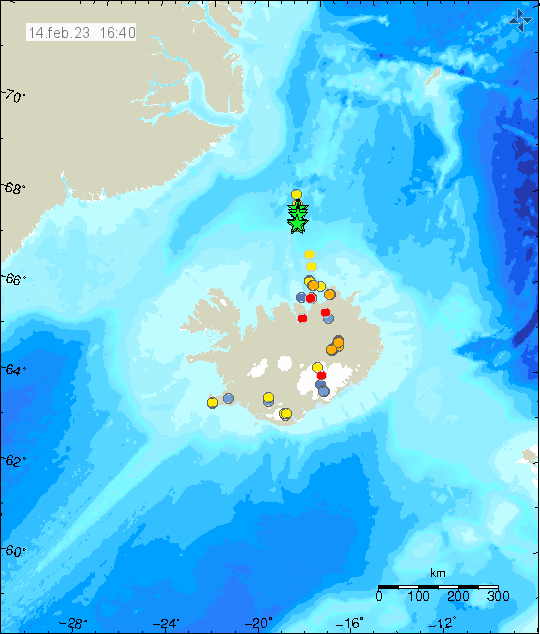
Icelandic Met Office has finished reviewing the earthquake activity north of Kolbeinsey and around eight earthquakes with magnitude above Mw3,0 took place. Largest earthquake had a magnitude of mb4,6 according to EMSC. Information about that earthquake can be found here.
Earthquake activity far north of Iceland. Copyright of this image belongs to Icelandic Met Office.
This earthquake activity appears to be over, but distance from seismic detection networks in Iceland prevents detection of smaller earthquakes that might be happening at this location.
It was reported in Rúv News that eruption is expected to happen in Fagradalsfjall volcano this year (2023) or next year (2024). When those eruptions happen is impossible to know. But before any eruption there’s going to be a large earthquake swarm as happened before the eruption in March 2021 and in August 2022. Fagradalsfjall volcano before the eruption in March 2021 had not erupted for 6000 to 8000 years. That means it unclear how the volcano is going to behave and its going to take a while until that is figured out, but for now it is probable that Fagradalsfjall volcano is going to work in similar way how Krafla volcano erupted between the year 1975 and 1984. With the difference that eruptions in Fagradalsfjall volcano are possibly going to last longer, based on data from other volcanoes on Reykjanes peninsula. This might go on for the next 10 to 20 years, with eruptions and quiet time period between them. Currently Fagradalsfjall volcano is in a quiet time.
This does not rule out eruptions in Reykjanes volcano (west of Fagradalsfjall volcano) and Krýsuvík-Trölladyngja volcano (east of Fagradalsfjall volcano) in next few years. Neither of those volcanoes have erupted in 700 to 900 years and at the writing of this article, don’t show any clear signs that they are about to erupt. Reykjanes volcano has had a lot of dyke intrusion activity since 2019, but no eruptions so far. Krýsuvík-Trölladyngja volcano has not had any dyke intrusion activity. Volcanoes east of Krýsuvík-Trölladyngja volcano, Brennisteinsfjöll volcano and Hengill volcano are currently quiet, but that might change without warning if magma starts to find path up those volcanoes.
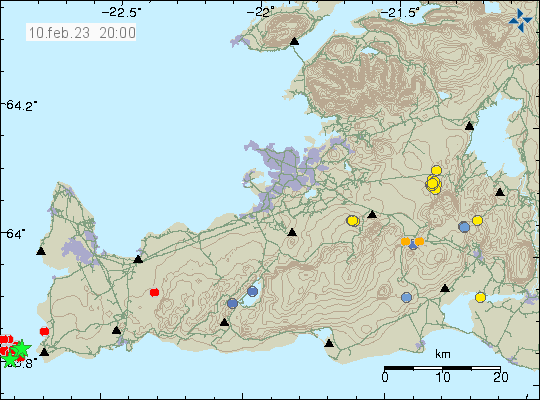
This earthquake swarm is ongoing at the writing of this article and information can change without warning. The largest earthquake recorded by automatic magnitude of Mw3,7 at the writing of this article. Around 30 to 40 earthquakes have happened so far, but that number might change quickly. This earthquake activity has some signs that it might be happening because of magma intrusion in the area, out in the ocean but signals are not clear.
The current earthquake activity on Reykjanes ridge. Copyright of this image belongs to Icelandic Met Office.
This earthquake activity is in the volcano Reykjanes, that volcano goes into the ocean and is on dry land. Making possible future eruptions both explosive and flowing magma at the same time. To date, Reykjanes volcano only has had earthquake swarms and no eruption. When that is going to change is impossible to know.
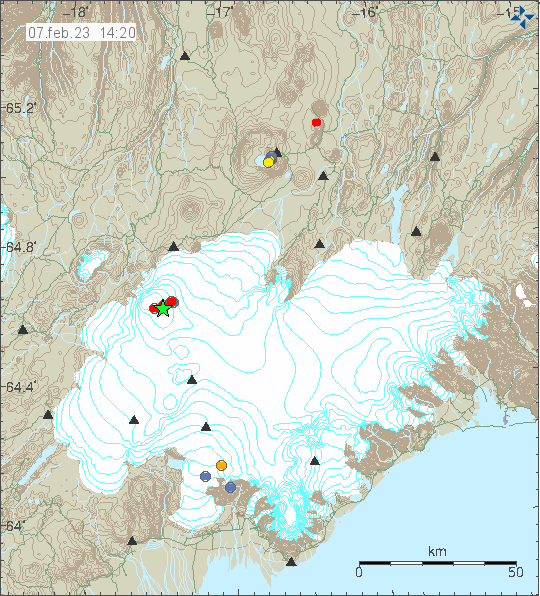
Today (7. February 2023) an small earthquake swarm took place. This earthquake swarm started at 11:21 UTC with a magnitude Mw3,2 earthquake and lasted until 12:05 UTC. Other earthquakes were smaller in magnitude.
Earthquake activity in Bárðarbunga volcano. Copyright of this image belongs to Icelandic Met Office.
This shows that Bárðarbunga volcano continues to inflate at high rate. Based on what happened before the eruption in 2014 to 2015 in Bárðarbunga volcano. When the earthquake stop for long time period it means Bárðarbunga volcano is ready for an eruption. While the earthquake activity happens is it is doing today, it means inflation continues in Bárðarbunga volcano.
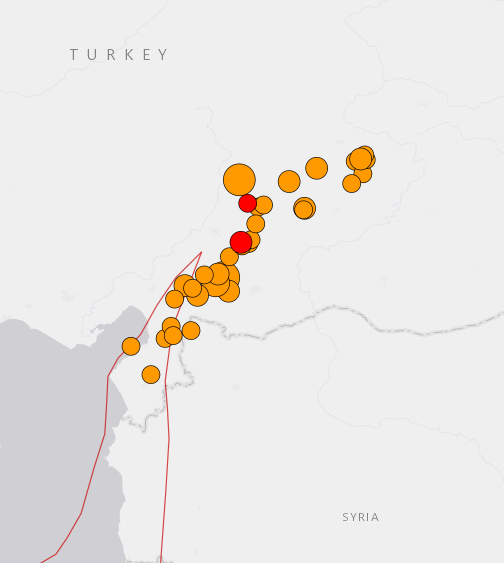
Today (06. February 2023) at 10:24 UTC an earthquake with magnitude of Mw7,5 took place. This earthquake took place less than 12 hours after the Mw7,8 earthquake took place 50 km south of this earthquake. USGS is reporting (seen on CNN) that 10000 people might have died in this earthquakes because of were it is located. The real number might be higher. News is also reporting that 582 people have died in Syria because of this earthquakes. There is heavy aftershock activity in this area and the second largest aftershock had a magnitude of Mw6,7 at 01:28 UTC.
Earthquake activity as it is on USGS map. Public domain/USGS.
Information about the Mw7,5 earthquake can be found here at EMSC and here at USGS. Information about the Mw6,7 earthquake can be found here at EMSC website.
Update (22:38 UTC)
The magnitude Mw7,5 earthquake has been confirmed to be an aftershock by USGS.
Today (6. February 2023) at 01:17 UTC an earthquake with magnitude of Mw7,8 took place in south Turkey. Damage is to be expected in this type of earthquake. This earthquake was felt over a wide area. Because of high electric price, I’ve been unable to run my seismometer in Denmark and I did not record this earthquake for that reason. At this magnitude this earthquake was recorded all over Europe in professional and citizen science seismometers.
EMSC information can be found here and USGS information can be found here. Links can stop working without warning.
This might not be anything at the writing of this article. Since there’s little earthquake activity in Katla volcano at the moment, its well below background noise. Over the last several months I’ve noticed an slight increase in larger earthquakes in Katla volcano, this might not mean anything, but I do not remember having seen this type of pattern in earthquake activity in Katla volcano before. Currently the earthquake activity is almost none and that means that for now there’s no risk of an eruption.
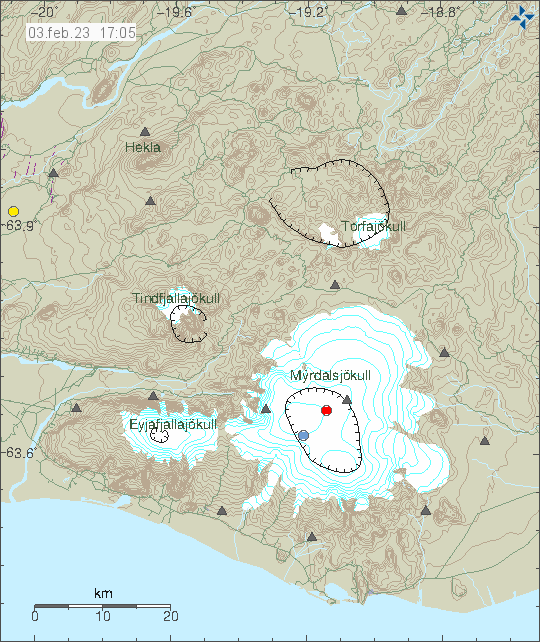
Minimal earthquake activity in Katla volcano today (3. February 2023). Copyright of this image belongs to Icelandic Met Office.
Largest earthquake today (3. February 2023) had a magnitude of Mw2,7. This is what has been happening in recent months. This one or two earthquakes that are slightly larger than what I consider normal. There’s a chance this might be normal and nothing more is going to happen, but for now, it is impossible to know for sure what is happening.
I’ve made the chose to start Iceland Geology channel. This is going to allow me to upload geology information in video format. How that is going to evolve is unclear, but I am going to work on this slowly over the next few years.
Iceland Geology YouTube channel can be found here. I have uploaded few videos, but since the channel is just recently in use I am still going trough verification process with YouTube. That limits my number of uploads until those are lifted. Since I am for now just uploading older videos that I’ve recorded in last few years.
Information for webicorders (online again from May or June) and e-mail postlist signup website are now under Iceland Geology menu option.
Cookie acceptance
We use cookies on our website to give you the most relevant experience by remembering your preferences and repeat visits. By clicking “Accept”, you consent to the use of ALL the cookies.
This website uses cookies to improve your experience while you navigate through the website. Out of these cookies, the cookies that are categorized as necessary are stored on your browser as they are essential for the working of basic functionalities of the website. We also use third-party cookies that help us analyze and understand how you use this website. These cookies will be stored in your browser only with your consent. You also have the option to opt-out of these cookies. But opting out of some of these cookies may have an effect on your browsing experience.
Necessary cookies are absolutely essential for the website to function properly. This category only includes cookies that ensures basic functionalities and security features of the website. These cookies do not store any personal information.
Functional cookies help to perform certain functionalities like sharing the content of the website on social media platforms, collect feedbacks, and other third-party features.
Performance cookies are used to understand and analyze the key performance indexes of the website which helps in delivering a better user experience for the visitors.
Analytical cookies are used to understand how visitors interact with the website. These cookies help provide information on metrics the number of visitors, bounce rate, traffic source, etc.
Advertisement cookies are used to provide visitors with relevant ads and marketing campaigns. These cookies track visitors across websites and collect information to provide customized ads.