Magnitude 3,4 earthquake 15 km north of Kolbeinsey island

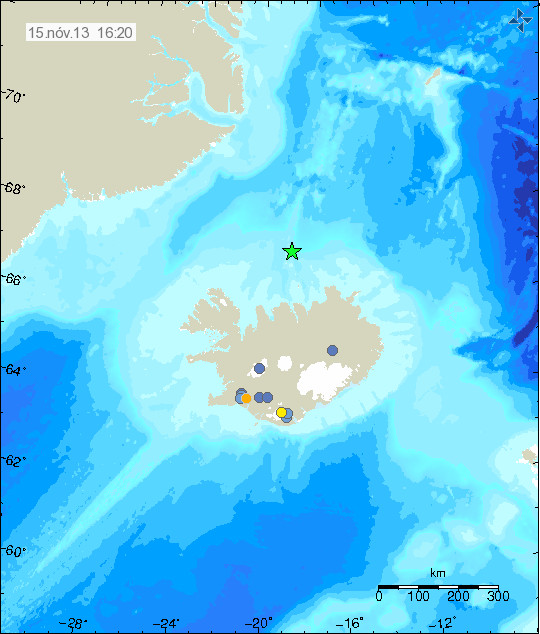
Today (15-November-2013) at 05:32 UTC an magnitude 3,4 earthquake took place 14,9 km north of Kolbeinsey island. The depth of this earthquake was 3,9 km according to Icelandic Meteorological Office. Due to distance from the SIL network the magnitude and depth might be underestimated.

131115_1620
The earthquake north of Kolbeinsey island is marked by the green star. Copyright of this image belongs to Icelandic Meteorological Office.
Due to distance from land it is difficult to know for sure what is happening at this location. So far no harmonic tremor has been detected so no eruption is taking place at this location. This earthquake did appear clearly on my geophone in Böðvarshólar. My geophone website can be found here.

Minor earthquake swarm on Reykjanes Ridge

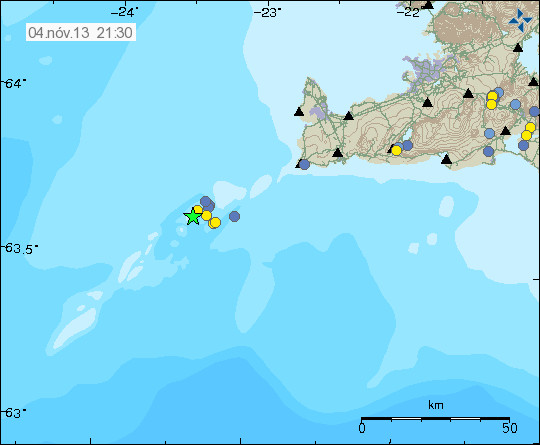
Today (04-November-2013) at 04:03 UTC an minor earthquake swarm took place on the Reykjanes ridge. The largest earthquake in this swarm had the magnitude of 3,2 and the depth of 12,2 km.

131104_2130
Earthquakes on the Reykjanes ridge. Copyright of this image belongs to Icelandic Meteorological Office.
Earthquakes are no uncommon in this area and there have been several earthquake swarm in past few weeks. Currently there are no signs of volcano activity taking place at this location and there are no clues or suggestions that such event is about to take place at present time. The largest earthquake did appear clearly on my geophone network and it can be viewed here on my geophone website.

Two minor earthquakes in Hekla volcano

I am sorry being late with this blog post.

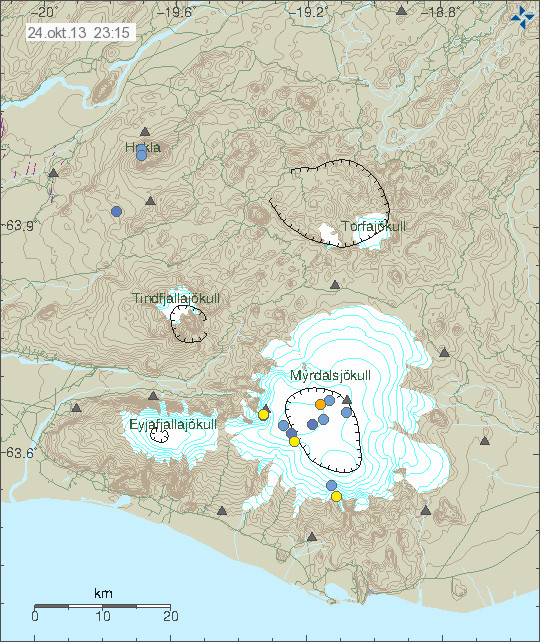
On Wednesday (23-October-2013) two earthquakes took place in Hekla volcano. One earthquake took place outside the main volcano, but inside the Hekla volcano system. All earthquakes were small with the largest one having the magnitude of 1,6 km. The two earthquakes in the main Hekla volcano are shallow earthquakes, the largest one (magnitude 1,6) just having the depth of 1,3 km. What is creating this earthquake activity remains unclear at present time.

131024_2315
Earthquake activity in Hekla volcano. Copyright of this image belongs to Icelandic Meteorological Office.

So far there are no signs of an eruption going to take place soon in Hekla volcano. Web cameras of Hekla volcano can be found here (jonfr.com), here (Rúv.is) and here (livefromiceland.is). My webicorder data can be found here (jonfr.com) online. The geophone at Heklubyggð detects earthquakes down to magnitude 0,0 if the weather is good, so if an eruption starts in Hekla volcano all the signs are going to appear clearly on that geophone as the activity starts.

Earthquake swarm on Tjörnes Fracture Zone

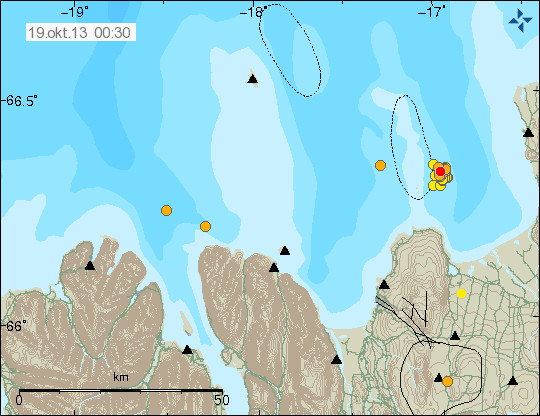
Yesterday (18-October-2013) an earthquake swarm started on Tjörnes Fracture Zone. This earthquake swarm has not been big, with largest earthquake only having the magnitude 2,5. This earthquake swarm is taking place at the end of an unnamed volcano that is in this area. The earthquakes appear to be only tectonic at this moment.

131019_0030
The earthquake swarm in Tjörnes Fracture Zone yesterday and today. Copyright of this image belongs to Icelandic Meteorological Office.

It is hard to know for sure if earthquake activity is going to continue in this area of Tjörnes Fractures Zone. Currently the activity remains low to moderate in this area, but no large earthquakes (over magnitude 4,0) have so far taken place in this area.

New earthquake swarm on Reykjanes ridge

Today (19-October-2013) new earthquake swarm started on the Reykjanes ridge. So far this earthquake swarm has been small, with only 16 earthquakes recorded. Largest earthquake in this swarm had magnitude 3,3 at the depth of 6,1 km.

131018_2320
The earthquake swarm on the Reykjanes ridge. The green star marks earthquakes with magnitude over 3,0. Copyright of this image belongs to Icelandic Meteorological Office.

I am expecting more earthquake activity in this area of the Reykjanes ridge over the next few days and weeks. It is impossible to know when an new earthquakes swarm starts. The best way is to monitor current activity at Icelandic Metorlogical Office website and on my webicorder website.

Possible volcano eruption in the year 2002 off the coast of north Iceland

Donation notice: If you can donate please do so. It helps me run this website and keeping up my work here. Information on how to donate can be found here. Thanks! 🙂

Few years ago there was an strong earthquake swarm 45 km north of Grímsey island, the earthquake swarm location was between Grímsey island and Kolbeinsey island. The strongest earthquake in that swarm had the magnitude of 5,5. It’s now considered a possibility that an minor eruption took place at this location when this earthquake swarm took place in the year 2002. This is according to an recent study into the volcano activity in this area. Since this part of the rift zone where volcanic activity continues where the Tjörnes Fracture Zone ends.

unnamed.volcano.svd.18-October-2013
Storagrunn volcano. Image from Vísir.is news, copyright belongs to Bryndís Brandsdóttir and other people connected to this work.

This volcano is located at depth at this location so any minor eruption is not going to get noticed on the surface of the ocean.

tfz.svd.18-October-2013
The earthquake swarm in this area in the year 2002 (vedur.is, Icelandic, images). Earthquakes larger than 3,0 are marked by green dots. Copyright on this image belongs to Icelandic Meteorological Office.

Icelandic News about this. Beware Google Translate.

Við misstum af síðasta eldgosi við Norðurland (Vísir.is, Icelandic)

Earthquake activity continues in Eyjafjallajökull volcano

Minor earthquake activity has continued since last week in Eyjafjallajökull volcano. This earthquake activity is so small that none of the earthquake have had the magnitude of 1,0. This earthquake activity is also shallow, less than 5 km depth. So it’s clearly not magma (at least not new one) that is creating this activity. I am not sure what is creating this activity in Eyjafjallajökull volcano at this point and I might never know.

131016_2345
Minor earthquake activity in Eyjafjallajökull volcano. Copyright of this image belongs to Icelandic Meteorological Office.

At current time there is no risk for an eruption from Eyjafjallajökull volcano. Since there is no new magma flowing into the volcano at present time. If you want to watch Eyjafjallajökull volcano you can do so here (jonfr.com) and here (mila.is) web cameras.

Earthquake swarm on Tjörnes Fracture Zone

On 14-October-2013 (Monday) an earthquake swarm started in Tjörnes Fracture Zone. This earthquake swarm has so far just been a minor one, with the largest earthquake being magnitude 2,5. The earthquake swarm appears to be currently ongoing.

131015_2210
Earthquake swarm in the Tjörnes Fracture Zone. Copyright of this image belongs to Icelandic Meteorological Office.

It’s hard to know for sure if this earthquake swarm is going to continue, but this area of TFZ has seen earthquake activity over the past few months. So there is a chance of more earthquake activity in the next days to weeks even months in this area.

Blog post updated at 23:25 UTC on 15-October-2013.

New earthquake swarm on Reykjanes peninsula and Reykjanes ridge

Today (15-October-2013) at 01:43 UTC a new earthquake swarm started on Reykjanes peninsula and Reykjanes ridge. So far the largest earthquake has the magnitude of 2,5. At the moment no larger earthquakes have taken place. This earthquake swarm is currently ongoing, but the rate of earthquakes has dropped over the day and is currently low.

131015_2050.2
The earthquake swarm on the Reykjanes peninsula. Copyright of this image belongs to Icelandic Meteorological Office.

131015_2050
The earthquake swarm on the Reykjanes ridge. It’s just off the coast. Copyright of this image belongs to Icelandic Meteorological Office.

This area of the Reykjanes has been seeing a lot of activity in recent days and its possible that more earthquake activity is going to take place at this location in next few days to months.

Blog post updated at 21:42 UTC.

Earthquake swarm on the Reykjanes peninsula

Today at 01:11 UTC (13-October-2013) an earthquake swarm started on the Reykjanes peninsula. Early in this earthquake it was just minor earthquakes until 07:34 UTC an earthquake with magnitude 4,8 took place on the Reykjanes peninsula. Before the strongest earthquake took place, an magnitude 3,4 and 3,5 took place. Several earthquakes with magnitude above 3,0 took place following the main earthquake. The strongest earthquake was felt over an wide area, from Vík í Mýrdal to Hólmavík in north-west Iceland. Far as I know no damage did take place following this earthquake.

131013_1415
The earthquake swarm on the Reykjanes peninsula. Green stars mark earthquakes with magnitude above 3,0. Copyright of this image belongs to Icelandic Meteorological Office.

This earthquake did appear clearly on all of my geophone stations in Iceland. They can be viewed here.

131013.073300.ebiz.psn
The magnitude 4,8 earthquake on the Eyrarbakki geophone station. The earthquake signal is strongest on this geophone station and clearly tops the sensor it self, it can be seen how the signal goes above the maximum line on the geophone image. This image is released under Creative Commons licence. Please see CC Licence page for more details on this licence.

131013.073300.hkbz.psn
The magnitude 4,8 earthquake at Heklubyggð geophone station. This image is released under Creative Commons licence. Please see CC Licence page for more details on this licence.

131013.073300.bhrz.psn
The magnitude 4,8 earthquake at Böðvarshólar geophone station. This image is released under Creative Commons licence. Please see CC Licence page for more details on this licence.

131013.073300.sktz.psn
The magnitude 4,8 earthquake at Skeiðflöt geophone station. The earthquake did appear clearly even if the noise level is high on that station. This image is released under Creative Commons licence. Please see CC Licence page for more details on this licence.

It is impossible to know for sure if this earthquake swarm is going to increase again. For the past few hours activity has been dropping, there is however nothing that says activity is not going to increase again. Such activity is common in this area, but it’s impossible to know for sure what happens next. At the moment there is nothing to suggest that volcano activity is the source of this activity. That might change but I think it is unlikely to be the case at the moment, regardless of what the future has in store.