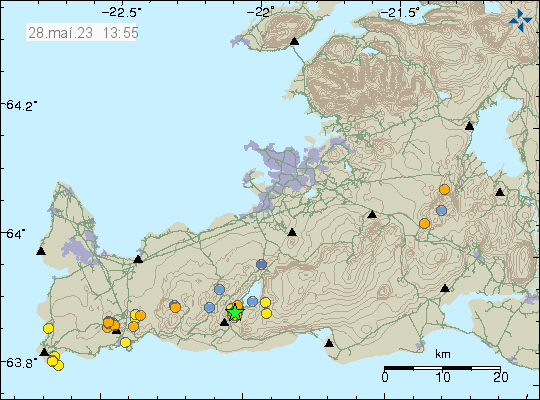
Yesterday an earthquake swarm started in Krýsuvík-Trölladyngja volcano. This earthquake swarm doesn’t appear (it might be connected, but it is difficult to know currently) to be connected to the inflation that is happening at Fagradalsfjall volcano. Largest earthquake in this earthquake swarm had a magnitude of Mw3,0. This earthquake swarm took place just south-west of Kleifarvatn lake.
Earthquake activity in Krýsuvík volcano. Copyright of this image belongs to Icelandic Met Office.
This earthquake swarm doesn’t seems to indicate an magma movement. There has not been any indicators (clear) that Krýsuvík-Trölladyngja volcano has gone active. It remains a dormant volcano.
The Icelandic Road administration did send out this news report today that new hot springs have been detected at Hveradalabrekka on Road 1 in Hengill volcano. This is an area that sees some heavy traffic. I can’t post pictures here because of copyright, but they can viewed in the news article below.
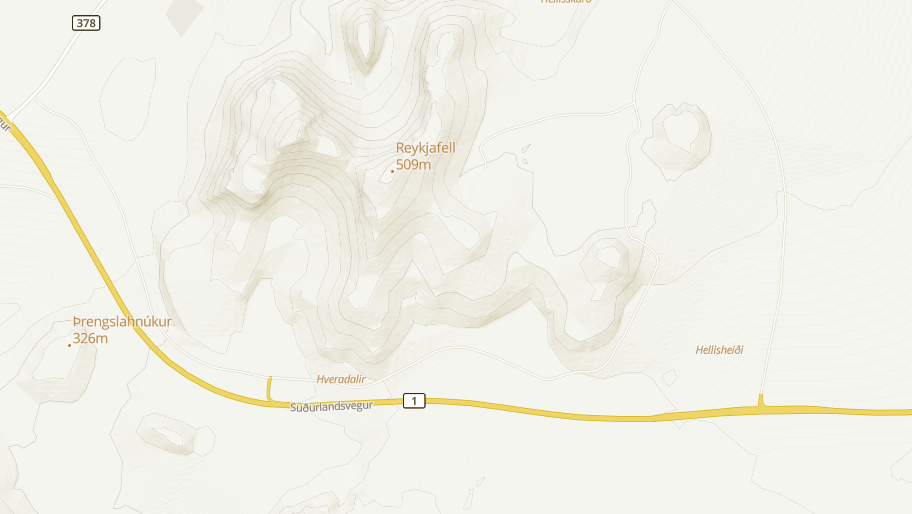
According to the Icelandic Road administration it seems that the area in question has been getting warmer for some time. According to them the current temperature around 86 degrees celsius. This is the area on a map from ja.is website.
The main road 1 on Hengill volcano. Close to the area that is now warming up. Screenshot of map from ja.is.
Next is to check why this is happening and if there is any risk the Road 1 in this area and if anything can be done if that’s the case. I am unclear on what is going on, since this area (I don’t think this one, but nearby) is known for hot spring activity. There has been some earthquake activity at this location in recent months and that is possibly connected to this new hot spring activity. On 9th of May this area had a Mw1,1 earthquake at the depth of 4 km. Over a time period of 130 days, the number of earthquakes in this area is not unusual for Hengill volcano or Reykjanes peninsula in general. This area of Road 1 might continue to get warmer over the next few months.
Rúv has published a news about this and has a video of the area where this new hot spring activity is happening. This is new because vegetation is in this area and is now dying off.
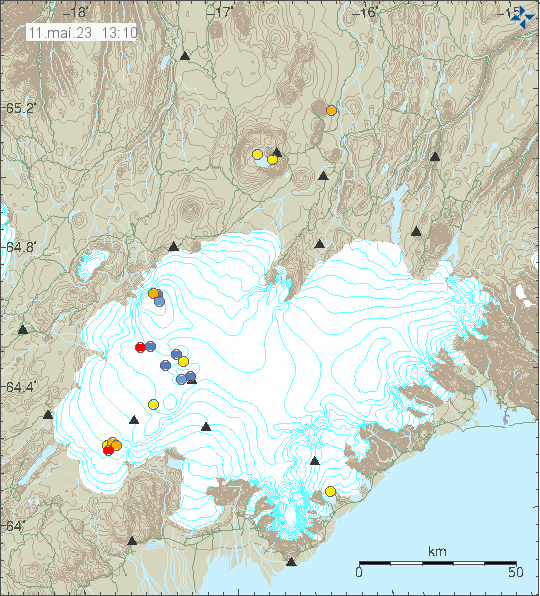
Today (11. May 2023) there was a earthquake swarm in Þórðarhyrna volcano. This are small earthquakes, but their location and depth suggest that this is a dyke intrusion taking place at this location.
Earthquake activity in Þórðarhyrna volcano. Copyright of this image belongs to Icelandic Met Office.
Þórðarhyrna volcano is part of Grímsfjall volcano fissure swarm, that connects to Laki eruption fissures. Last eruption in Þórðarhyrna volcano was in the year 1902 to 1904 and had the VEI=4 according to Global Volcanism Program report that can be read here.
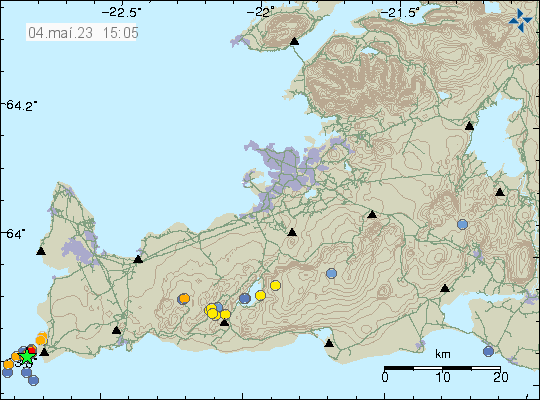
During the night of 4. May 2023 an earthquake swarm took place in the Reykjanes volcano out in the ocean. This was not a large earthquake swarm. Largest earthquake recorded had a magnitude of Mw3,4. Other earthquakes where smaller in magnitude.
Earthquake swarm in Reykjanes volcano. Copyright of this image belongs to Icelandic Met Office.
This earthquake activity suggests an dyke intrusion in this area. This is part of Reykjanes volcano, but that volcano is in part out in the ocean. The Reykjanes volcano has been having regular dyke intrusion in recent years without it resulting in an eruption. That is most likely what is going to happen now.
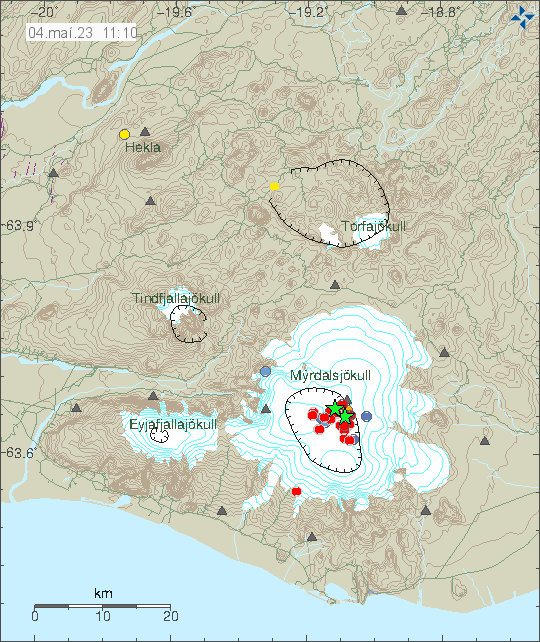
This morning there was a strong earthquake swarm in Katla volcano. At the writing of this article the largest earthquake had a magnitude of Mw4,8 and the second largest earthquake had a magnitude of Mw4,7, the third largest earthquake had a magnitude of Mw4,5. This earthquakes where felt in nearby farms and towns close to Katla volcano. Currently, a lot of smaller earthquakes have happened in Katla volcano.
Earthquake activity in Katla volcano. Copyright of this image belongs to Icelandic Met Office.
There are no changes in harmonic tremor levels at the writing of this article. That makes an eruption unlikely to happen now. That might change later without warning. The air aviation code has been moved to yellow and can be viewed here.
I’ll write a new article if something more happens.
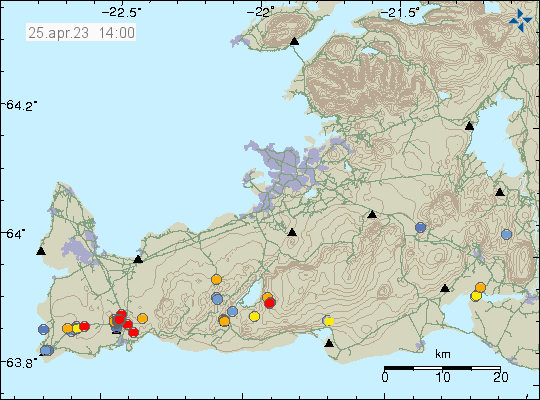
This morning (25. April 2023) an earthquake swarm started north of Grindavík town, next to the Blue Lagoon. This earthquake swarm is ongoing at the writing of this article. If this is going to result in a eruption is impossible to know. The magma has reached the depth of 2 km and that is not good news if this continues to intensify. Large earthquakes do not need to happen before an eruption starts under the correct conditions in the curst and there has been a lot of dyke activity in Reykjanes volcano in last 3 years. Without that activity resulting in a eruption.
Earthquake activity north of Grindavík town. Copyright of this image belongs to Icelandic Met Office.
Eruption at this location would be bad, because of the tourist infrastructure next to this location that is the Blue Lagoon. Only thing that can be done now is to monitor the situation and see if it changes from what is currently happening.
It is possible to view the earthquake swarm in high resolution on Skjálfta-Lísa and other private websites that have similar maps.
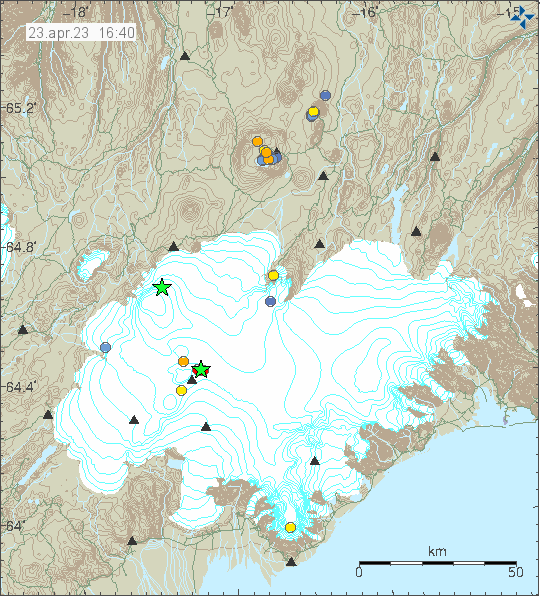
Today (23. April 2023) at 15:!5 UTC an earthquake swarm took place in Grímsfjall volcano. Largest earthquake in this swarm had a magnitude of Mw3,3. Few other smaller earthquakes also took place.
Earthquake activity in Grímsfjall volcano. Copyright of this image belongs to Icelandic Met Office.
There are no signs that Grímsfjall volcano is about erupt following this earthquake swarm. That might change without warning, but seems unlikely to happen at the moment. More earthquakes might happen in next few hours.
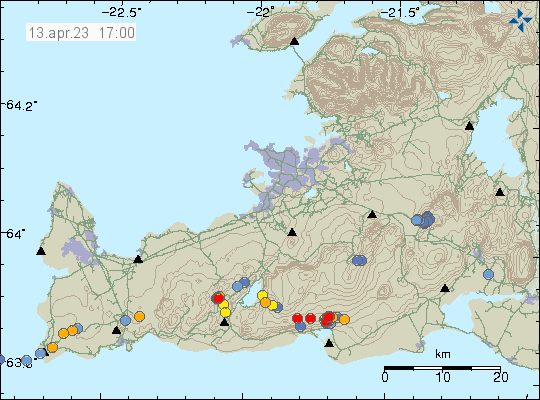
Today (13. April 2023) there has been a small earthquake swarm in south part of Brennisteinfjöll volcano. This location had an earthquake swarm few weeks ago at this same location. It also was small in magnitude. Depth of this earthquake swarm has now decreased from 7 km to around 3 km. At least that is what it seems, based on the current earthquake data.
Earthquake activity in Brennisteinsfjöll volcano. Copyright of this image belongs to Icelandic Met Office.
This earthquake activity shows a sign of magma movement. It is my opinion that the magma is now pushing it self trough the crust at this location. That can take a while, up to several weeks before an eruption starts. I did see something similar happen before the Bárðarbunga volcano eruption in 2014. That process took good three months before the eruption and was marked by small earthquake swarm like this one. How long this is going to take is impossible to know, because what type of crust is at this location is not well understood (outside of types of rock it is made out of at the first top layers). This is in my view an earthquake activity that needs to be monitored, because of possible eruption risk at this location. This is directly north of a small lake south of the earthquake swarm. If an eruption happens and the lava flows into the lake, that might create a lot of problems.
This earthquake swarm can be viewed here in more details. The website is Skjálfta-Lísa and is only in Icelandic.
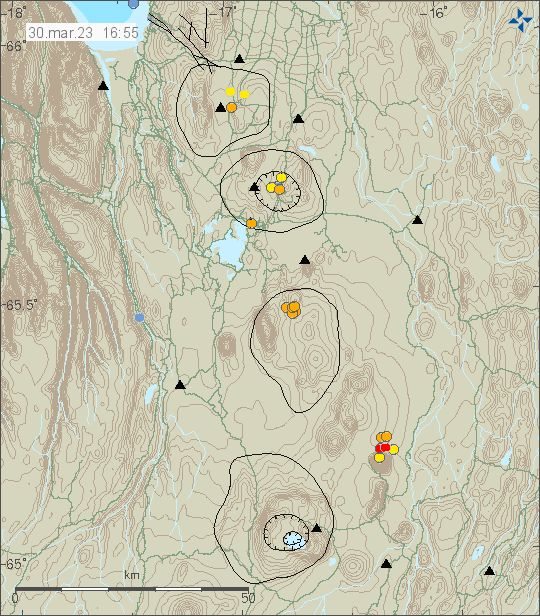
An earthquake swarm in a volcano called Fremrinámar today (30. March 2023). This is the first time I’ve seen an earthquake swarm in this volcano. All earthquakes where small in magnitude and the magnitude range was from Mw0,1 to Mw1,0. Depth was 5,8 km to 9,1 km.
Fremrinámar is located south of Krafla volcano. Copyright of this image belongs to Icelandic Met Office.
This is the first time I’ve seen an earthquake activity in this volcano. I’ve been monitoring earthquake activity for close to 30 years at the writing of this article. Last eruption in Fremrinámar volcano took place around 3200 years ago (1200 BCE according to Global Volcanism Program). There is a second (and I assume newly discovered) volcano north of Fremrinámar volcano and south of Krafla volcano called Heiðarsporðar. That volcano last erupted around 2200 years ago. This earthquake activity doesn’t seems to be in that volcano, but this map on Icelandic Met Office website is not fully up to date it seems. Based on the volcano website Catalogue of Icelandic Volcanoes. This earthquake activity is only mentioned here now, because I’ve never seen an earthquake swarm in this volcano before.
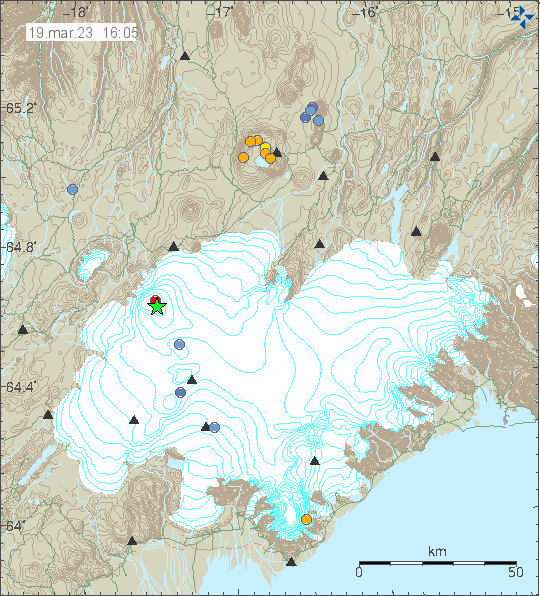
Today (19. March 2023) at 14:59 UTC an earthquake with magnitude of Mw3,1 took place in Bárðarbunga volcano. This is normal earthquake activity and shows the inflation that is happening in Bárðarbunga volcano is ongoing after the end of the eruption in 2015.
Earthquake activity in Bárðarbunga volcano. Copyright of this image belongs to Icelandic Met Office.
This type of earthquake activity happens once to twice a month with a earthquake close to magnitude five happening every three to four months. This earthquake activity is getting lower with time, it is likely that it is going to take few more years until it completely stops.
Cookie acceptance
We use cookies on our website to give you the most relevant experience by remembering your preferences and repeat visits. By clicking “Accept”, you consent to the use of ALL the cookies.
This website uses cookies to improve your experience while you navigate through the website. Out of these cookies, the cookies that are categorized as necessary are stored on your browser as they are essential for the working of basic functionalities of the website. We also use third-party cookies that help us analyze and understand how you use this website. These cookies will be stored in your browser only with your consent. You also have the option to opt-out of these cookies. But opting out of some of these cookies may have an effect on your browsing experience.
Necessary cookies are absolutely essential for the website to function properly. This category only includes cookies that ensures basic functionalities and security features of the website. These cookies do not store any personal information.
Functional cookies help to perform certain functionalities like sharing the content of the website on social media platforms, collect feedbacks, and other third-party features.
Performance cookies are used to understand and analyze the key performance indexes of the website which helps in delivering a better user experience for the visitors.
Analytical cookies are used to understand how visitors interact with the website. These cookies help provide information on metrics the number of visitors, bounce rate, traffic source, etc.
Advertisement cookies are used to provide visitors with relevant ads and marketing campaigns. These cookies track visitors across websites and collect information to provide customized ads.