Minor earthquake swarm in Katla volcano
Today (28.05.2012) at 11:22 UTC an small earthquake swarm did start in Katla volcano. This earthquake swarm did end at 12:28 UTC. This is small earthquake swarm, both in numbers of earthquakes and in the magnitude of the earthquakes in the swarm. With the largest earthquake having the magnitude of ML1.4. The depth of this earthquake swarm was around 0.1 km, but that gives the depth around 100 meters or so. Following this earthquake there has been some minor disturbance at Álftagróf SIL station. But because it only appears on one SIL station. This change might have its origin in something else. Like human traffic, local wind etc. For the moment I cannot rule that out.
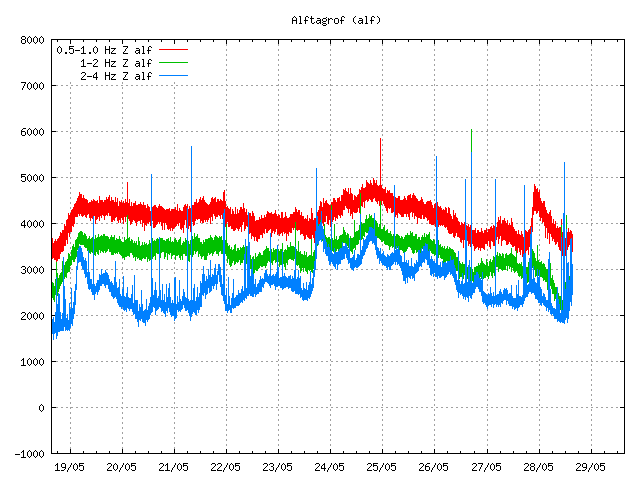
The change in tremor at Álftagróf SIL station. This change in tremor might not be because of Katla volcano. But something else. Please keep that in mind. Copyright of this picture belongs to Iceland Meteorological Office.
If the tremor changes at Álftagróf SIL station where from Katla volcano. They where highly local and did not show up on other SIL stations for some unknown reason. That has happened before, but the SIL network was not as dense around Katla volcano back then.
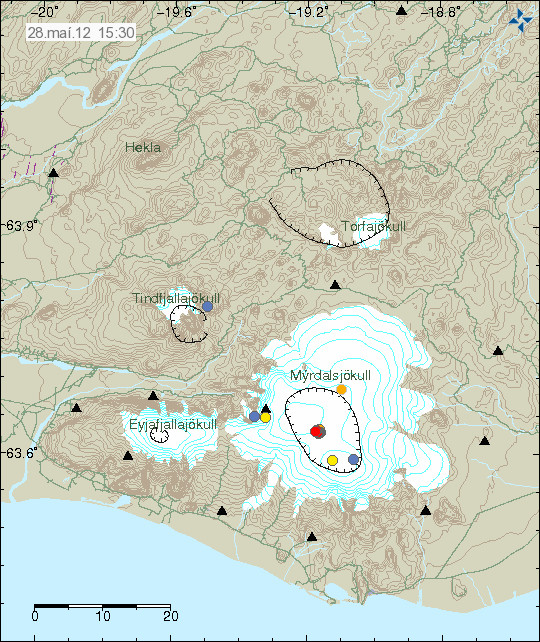
Image of the active area in Katla volcano. Copyright of this picture belongs to Iceland Meteorological Office.
I find it most likely reason for this earthquake swarm where some changes in hydrothermal areas inside Katla volcano caldera. All hydrotheraml areas in Katla volcano are under high pressure due to the glacier that is on top of them. So changes might not happen without some earthquake activity as did happen few hours ago. This is also not in any way a sign that Katla volcano might be about to erupt. This is far too low earthquake activity for such event to be starting. There is an chance of small glacier flood following this earthquake swarm in next 8 to 24 hours. But it is far from certain that is going to happen.
Krísuvík volcano inflates and deflates regularly
It seems that Krísuvík volcano is inflating and deflating on regular basic. I do not know how regular this change is. But it has been noticed by Icelandic scientists how are bit puzzled by this behavior. Last inflation episode did last until end of the year 2011. Since then deflation did start again and is currently ongoing. It is uncertain if what this means. At the moment it is too early to know for sure if this means if that Krísuvík volcano is getting ready for an eruption. But if there was an eruption in Krísuvík volcano, it would be Hawaiian eruption so no volcano ash. Volcano ash eruption would only take place if an eruption started in Kleifarvatn lake. But the effects of that would be limited to local area (Reykjavík and other nearby towns). It would not create any global problems, as many would want to believe.
Inflation and deflation period have been the years 2009, from January to September. In May 2010 inflation did start again, that inflation period lasted until end of the year 2011. Since then deflation has been taking place. Today there is continues GPS monitoring in Krísuvík volcano. But it is unknown if this type of behavior has taken place before in Krísuvík volcano. But for now Krísuvík volcano is being monitored both with GPS and the SIL network. What happens next anyone guess.
Icelandic news about this.
Land rís og sígur í Krýsuvík (Rúv.is)
Earthquake swarm continues close to Herðubreið. Earthquake activity in Katla volcano
The earthquake swarm that started in Herðubreið two days ago continues. So far over 100 earthquakes have been recorded. Most of them are less then ML2.0 in magnitude. But this earthquake swarm continues at slow rate. This is not a big earthquake swarm. Based on number (in my system) of earthquakes pr hour. But in my system, a large earthquake swarm has tens to hundreds of earthquakes pr hour.
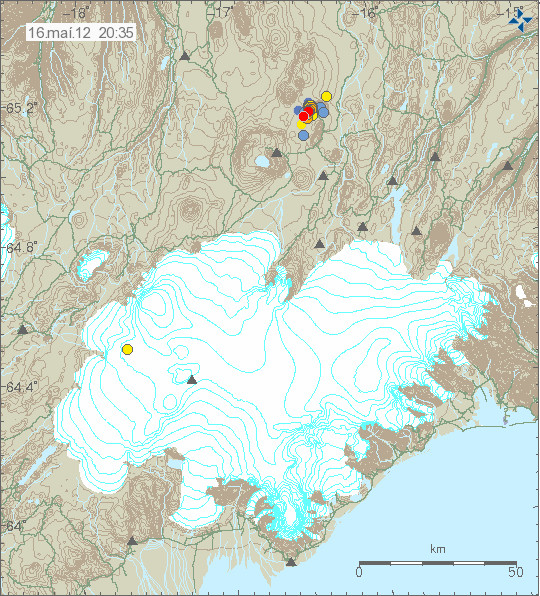
The earthquake swarm in Herðubreið. Copyright of this image belongs to Iceland Meteorological Office.
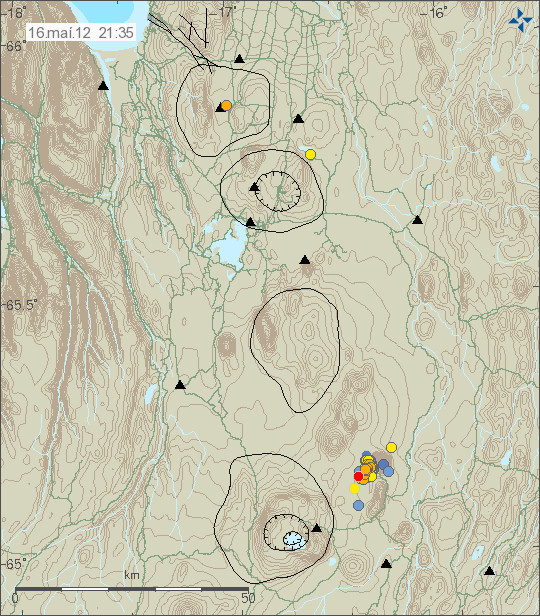
A bit higher resolution of the earthquake swarm in Herðubreið. Copyright of this image belongs to Iceland Meteorological Office.
Katla volcano
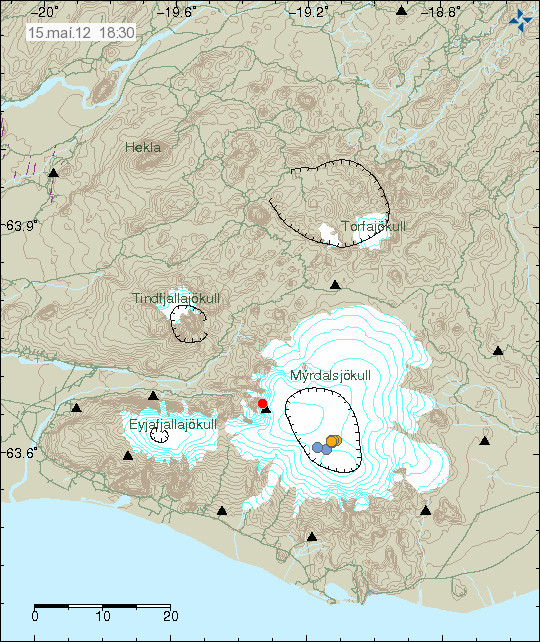
There is some earthquake activity in Katla volcano. But it is not high. There was one small earthquake this evening (it did appear on my Skeiðflöt geophone). But it has not been reviewed. So both size and depth are going to change.

Earthquake activity in Katla volcano during the past few days and until today. Copyright of this image belongs to Iceland Meteorological Office.
The earthquake activity in Katla volcano is also showing interesting pattern during this week (Week 20). It seems that earthquake activity is focusing on one point inside the caldera. It is hard to know for sure what this means at current time. But it is my opinion that it is not a good sign. But so far, nothing major has been happening inside Katla volcano caldera at this time. Until that happens, it is just best to keep watch and keep speculations within the amount of what is going on.
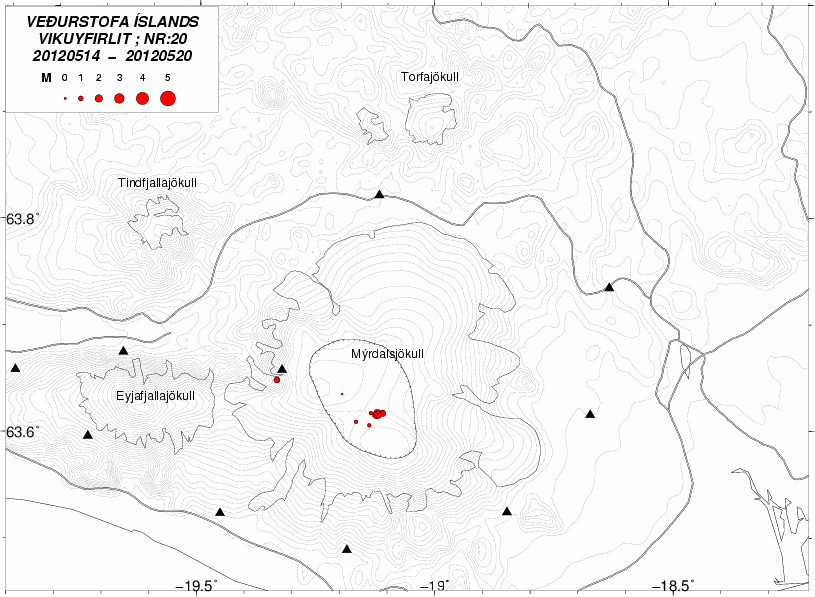
Earthquake activity in Katla volcano during Week 20 (current week). Copyright of this image belongs to Iceland Meteorological Office.
Beside this activity. It has been quiet in Iceland now for several weeks now. That is not un-common to happen during some years. While other years are often more active, some years are quiet. It is not clear yet if the year 2012 is going to be quiet year in Iceland or not.
Earthquakes in Katla volcano. Earthquake swarm continues close to Herðubreið. Other earthquake activity
This morning there was a short earthquake swarm in Katla volcano caldera. This earthquake looks like a minor dike intrusion did take place this morning. Current series of events did start on 28. April 2012. With a small earthquake event and a small glacier flood that did follow it. Along with harmonic tremors coming from the glacier flood and possibly Katla volcano caldera (hydro-thermal activity boiling or something of that nature). I do not yet know if there was any glacier flood following the event this morning. But so far there is nothing that suggests a small glacier flood did take place following the earthquake swarm this morning.
The earthquake swarm this morning took place on an location that did erupt on 8 and 9th of July 2011. So it is clear the area that erupted last year is picking up activity again. But there was an drop in activity from end of November 2011 until end of April 2012.
Earthquake activity in Katla volcano this morning. Copyright of this picture belongs to Icelandic Meteorological Office.
This earthquake activity did appear well on my geophone at Skeiðflöt farm.

Earthquake activity in Katla volcano caldera this morning on my Skeiðflöt geophone. There is a lot of noise on this geophone. But earthquake activity can still be seen on this. The earthquakes are marked by red (some noise is also marked by red). This picture is released under Creative Commons Licence. See CC Licence page for more details.
It is clear that Katla volcano seems to be warming up to an eruption. But it is impossible to know when such eruption might happen, or how big it is going to be.
Herðubreið
Earthquake activity continues south-west of Herðubreið. But almost all of the earthquakes have been less then ML2.0 in magnitude. Earthquake activity has been slowing down all day. At the moment, it appears this earthquake swarm is close to being over.
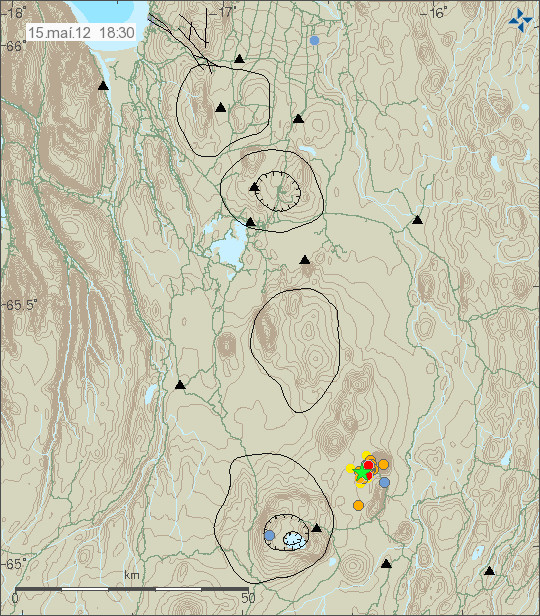
The earthquake activity close to Herðubreið mountain. Copyright of this picture belongs to Icelandic Meteorological Office.
This area is well known for for earthquake activity. So this is not something that is new in this area.
Reykjanes Ridge
According to EMSC and USGS there have been several earthquakes with the magnitude of Mb4.5 to Mb4.8 on the Reykjanes Ridge. Earthquake activity is common on the Reykjanes Ridge. But because of the location and depth (around 2km) it is impossible to know if there any volcano eruption taking place at this location. It might well be, or not.
Kolbeinsey Island
Over the past weeks there has been some earthquake activity close to or in Kolbeinsey Island. The largest earthquakes have had the magnitude around ML3.0, with some underestimates due to distance from the SIL network. At this moment it is impossible to know if this earthquake activity is related to possible eruption activity. But it believed that an eruption (or dike intrusion) took place on Kolbeinsey Ridge in the year 1999. It started off with a large earthquake swarm.
Katla volcano warming up for an eruption. Small glacier flood continues
This is going to be a short blog post. As I am going to be short of table and a cheer for few more days.
It seems that Katla volcano is warming up for a eruption. As I did mention in last blog post. But there is more to this. As the glacier flood that started on the 28. April 2012 continues according to a email that I got from an geologist working at Iceland Meteorological Office. But that suggests two things. That there is currently an ongoing melting of glacier taking place in Katla volcano, or there is a slow drainage taking place from some area in Mýrdalsjökull glacier. But given increased conductivity following this it is clear that this water has been in contact with magma. But that can be seen with the increased conductivity in the water.
There have not been many earthquakes following this events. But from the earthquakes that have happened. It seems that most likely source for current events is close to or the same area that erupted in July 2011. But at the moment this is just speculation based on limited data. It has not been confirmed so far.
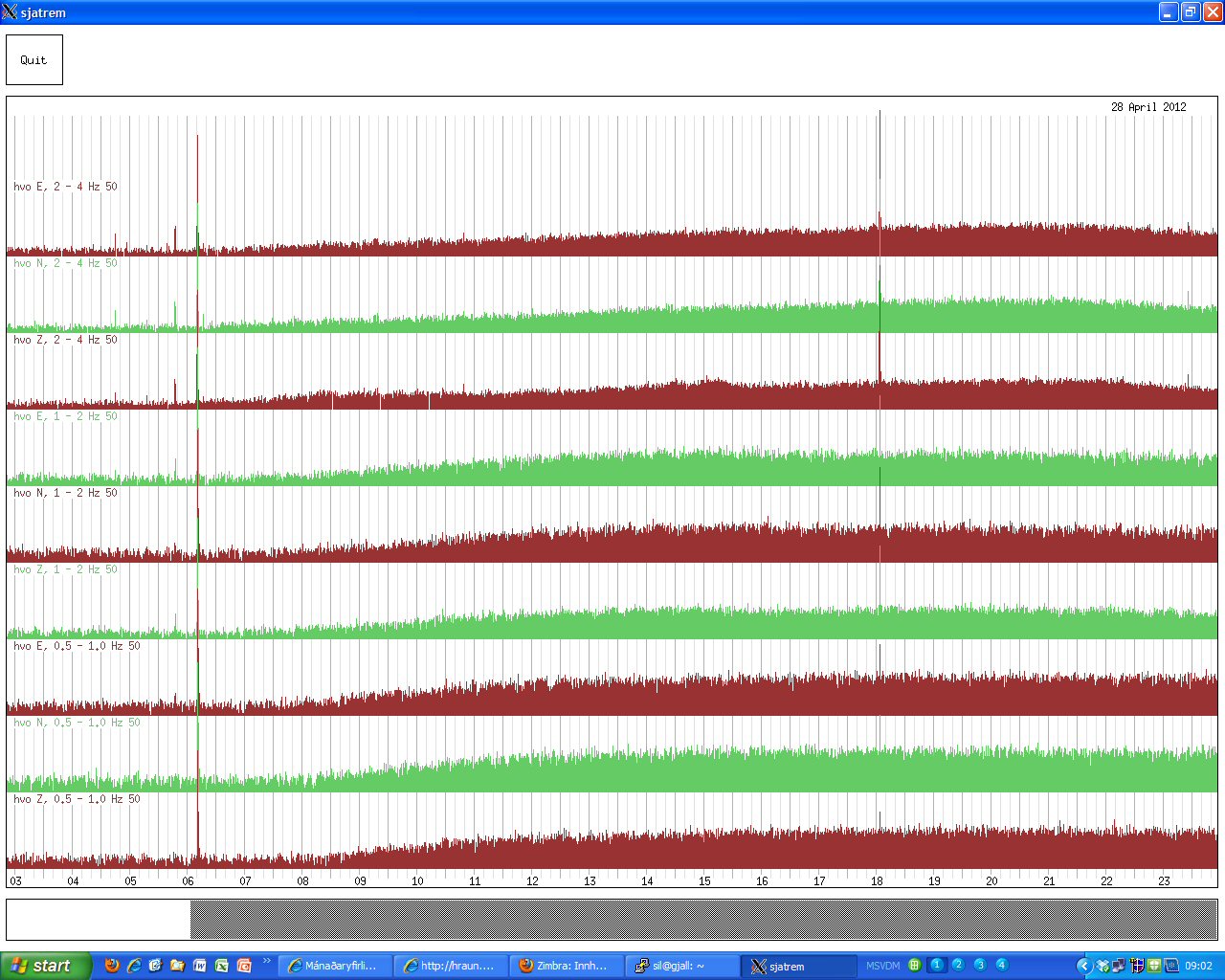
The harmonic tremor that started on 28. April 2012. This is Lágu Hvolar SIL station. Copyright of this picture belongs to Iceland Meteorological Office. Used with written permission.
This plot shows clearly how the harmonic tremor starts and continues at same level for several days. I do not know if the harmonic tremor is ongoing. But I find it likely, if the small glacier flood is currently going on (that was my last information, but things might have changed during the day). But it is hard for me to know that for sure. But based on latest data from the water monitoring system around Katla volcano, the spike in this glacier flood is most likely over for now. But it impossible to know what happens next in Katla volcano. All that can be done is to wait and see what happens next.
Small glacier flood from Mýrdalsjökull glacier on 28. April 2012 [Updated]
This has to be short. I do not have any table to cheer right now. I have already bought one (used and cheap). But I get it next week. I also do not yet have a ADSL connection so far. But this is what happens when one moves between countries.
On the 28. April 2012 there was a small glacier flood from Mýrdalsjökull glacier that on top of Katla volcano. This activity did start few days earlier according to Iceland Meteorological Office. But it did peak on the 28. April 2012. This was then followed by a small glacier flood in Múlakvísl river. The same river that had the glacer flood last summer, that did destroy a bridge in that same area.
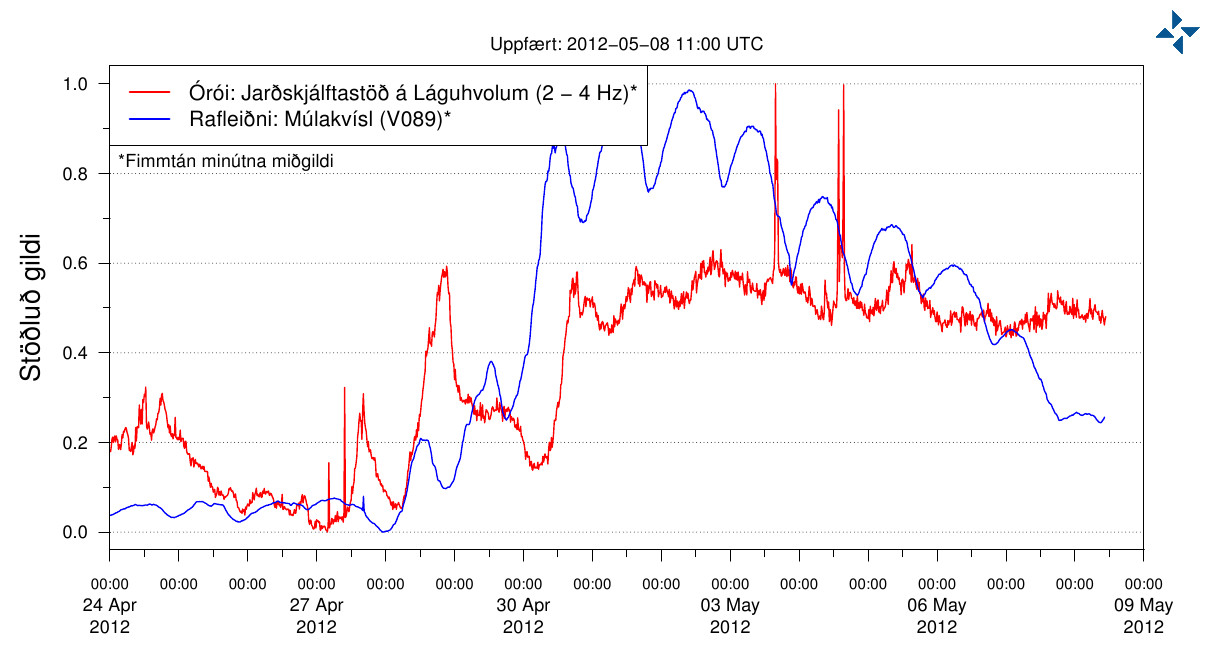
The red line marks the harmonic tremor of Katla volcano. The blue line marks the conductivity in Múlakvísl glacier river. This is from Week 18 of the year 2012. Copyright of this picture belongs to Iceland Meteorological Office.
There was also a second event that took place in Katla volcano on 6 and 7. May 2012. But I do not know if there was any glacier flood in Múlakvísk glacier river following that event. Buit it is clear that Katla volcano is warming up again. This events are clearly something that I consider a warning on what is going on in Katla volcano. But it is a question if it continues or just stops, as so often does happen with volcanoes.
Update 1: According to a email answer that I got with a question of mine. This glacier flood is currently ongoing. It has not stopped so far. But this is a small glacier flood. But this is a interesting what is going on in Katla volcano at the moment.
Icelandic news about this.
Smáhlaup í Múlakvísl (mbl.is, Icelandic)
Blog post updated at 14:38 CEST on 11.05.2012.
Iceland newest volcano (short of)
Iceland has many surprising things. Among those surprises is a volcano named Snæfell. I did mention it shortly yesterday. Now it is time for the long version of what this volcano is about. Snæfell volcano is a tall mountain, but it is 1883 meters above sea level. That makes it the highest mountain in Iceland outside of Vatnajökull glacier. Snæfell volcano has a small glaciers (more then one) on is top.
Snæfell volcano is the newest addition to Icelandic volcanoes. Little is currently known about Snæfell as a volcano. But it is now known that it has not erupted for at least 100.000 to 120.000 years. But it is debated among scientists if any eruptions have taken place after last ice-age. But that is around 12.000 years ago. The basic volcano system of Snæfell is in the direction of NNE, with eruption features going along those lines.
Origins of Snæfell volcano can be traced to several lava eruptions that started at least about 400.000 years ago. On top of that eruption even Snæfell volcano has been built by repeated eruptions in this area. Snæfell volcano belongs to the same volcano zone as Öræfajökull volcano and Esjufjöll volcano. In order with other volcanoes on this active volcano zone. It has little to no activity as I have
I do not know of any hydro-thermal areas close to Snæfell volcano. But that is not a surprise. Given how long it is since magma was on the move in this volcano. All the time that I have been watching for earthquakes in Iceland (well over 10 years now). I have never seen any earthquake activity in Snæfell volcano during that period.
South-east of Snæfell volcano is a extinct volcano. It has been weathered down by nature. I do not know how old it is. But that suggests that volcano activity in this area is not something new. Closest SIL station to Snæfell volcano is Vestari Sauðarhnjúkur.

Volcano and fault-line map of Iceland. Snæfell volcano can be seen on this map. Copyright of this picture belongs to Náttúrufræðistofnun Íslands. This picture is from this web site here.
Reference:
Eldvirkni Snæfells og Kárahnjúka tímasett (Morgunblaðið, 2005)
Snæfell og Nágrenni (OS.is, 2000)
Blog post updated at 22:43 CEST on 8 May 2012.
Allt quiet in Iceland
It has been rather quiet in Iceland during the past several weeks. March for instance was unusually quiet. I suspect that April was also rather quiet earthquake wise in Iceland. With nothing special going on. I have currently limited to write about. But I am going to write about few volcanoes in Iceland and there history if there is any history to write about. But there is always some interesting information about volcanoes in Iceland.
Even the newest Icelandic volcano. Named Snæfell (no GVP website as of yet) and is located east of Vatnajökull glacier. It has not erupted for at least 12.000 years. But it is a part of the volcano arch that is made up of Öræfajökull, Esjufjöll volcanoes. Here are some information about in Icelandic. But I am going to write more on it later on. When I have my writer computer back up after I finish moving to Denmark properly.
National Geographic – How Volcanoes Form
National Geographic on how volcanoes work.