Earthquake swarm in TFZ

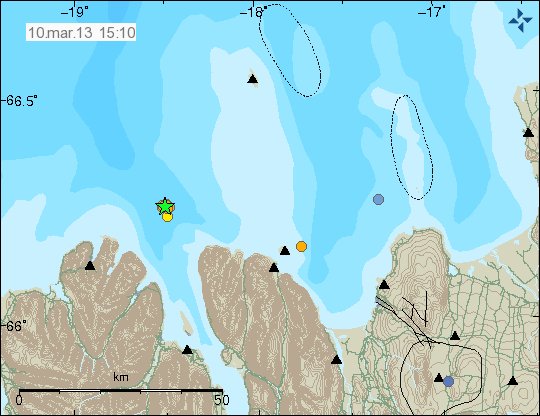
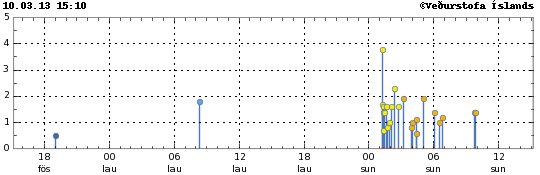
During the night an earthquake swarm started in TFZ. The first earthquake had the magnitude of Mw3.8 according Icelandic Meteorological Office. This earthquake was felt clearly in the area it has been reported. Above 20 aftershocks have been recorded in this area following this earthquake.

130310_1510
Location of the magnitude 3.8 earthquake in TFZ. Copyright of this image belongs to Icelandic Meteorological Office.

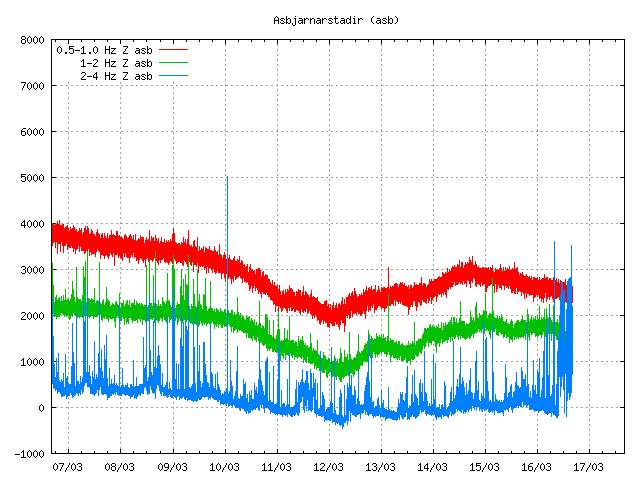
130310_1510_mag_trace
Trace of the earthquake activity. Copyright of this image belongs to Icelandic Meteorological Office.

bhrz.svd.15.30.utc.10.03.2013
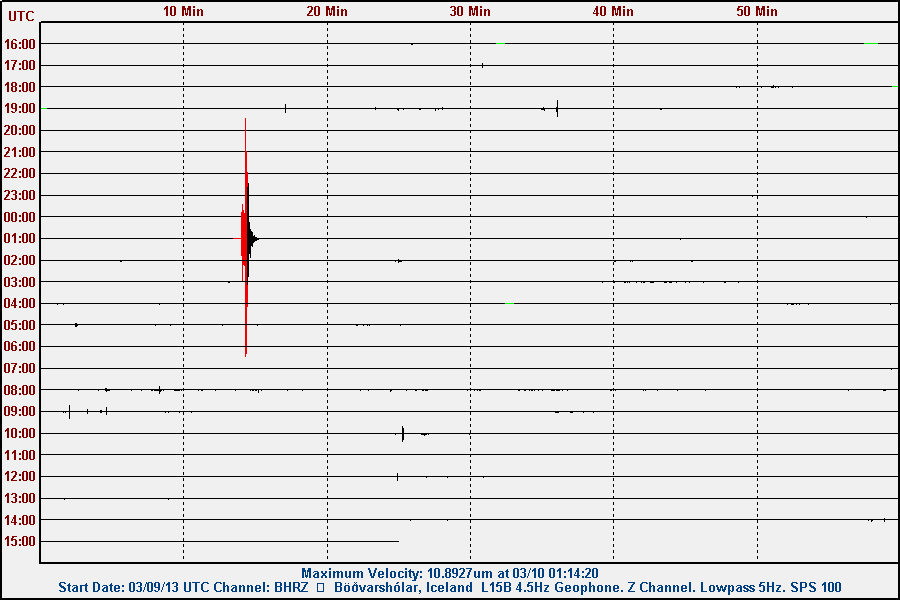
This earthquake was well detected on my geophone in north Iceland. This image is released under CC Licence. Please see CC Licence page for more details.

It is possible to watch this earthquake activity on my geophone network page here. At the moment the earthquake activity has stopped. It is impossible to know if it is going to start again in this area or not. But this area is normally highly active in terms of earthquake activity during the year. So earthquakes swarms like this are not uncommon.

Deep earthquake swarm in Tungafellsjökull volcano

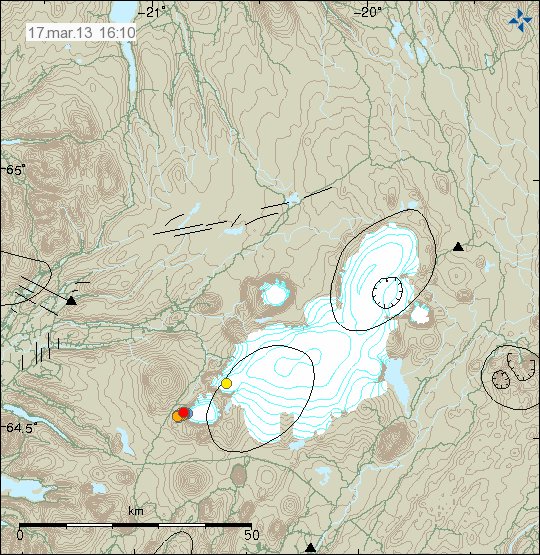
Today (03.03.2013) between 13:19 UTC and to 13:21 UTC a deep earthquake swarm took place in a volcano named Tungnafellsjökull. This was a minor earthquake swarm, with the largest earthquake having magnitude 1.4. But it is the depth that is important here. The depth was most at 28 km, with the shallowest earthquake having the depth 18.7 km. This suggest magma intrusion into the volcano at depth. A pattern that was seen during the Eyjafjallajökull volcano eruption as an example.

For the past few months. Tungnafellsjökull volcano has been having swarms of earthquakes. All of them small, but many of them above 2.0 in magnitude. But so far none above magnitude 3.0. While earthquake activity has remained low in Tungnafellsjökull volcano I find that events are speeding up there in the past few months. With the terms that more earthquakes are being detected in this volcano and now at more depth. I find this worrying and also interesting. This volcano is far from any populated area, so any damage resulting for an eruption in it should be minimal. It also has no glacier to speak of. There is going to be a bad weather in Iceland until Friday (according to the weather forecast at the moment), so detecting any small earthquakes in this area might be limited by it.

130303_1655
The red dots show the earthquake activity in Tungnafellsjökull volcano. Copyright of this image belongs to Icelandic Meteorological Office.

It is too early to know what happens in Tungafellsjökull volcano. It is also important to note that Tungnafelljökull volcano has never erupted in historical times. This makes figuring out what happens next in it more difficult then ever. This activity might not mean an eruption is imminent. But at the moment I cannot rule one out just yet. It is clear that more activity is going to be needed before the picture of what is taking place in Tungnafellsjökull volcano gets clearer.

Interesting earthquake swarm in Katla volcano

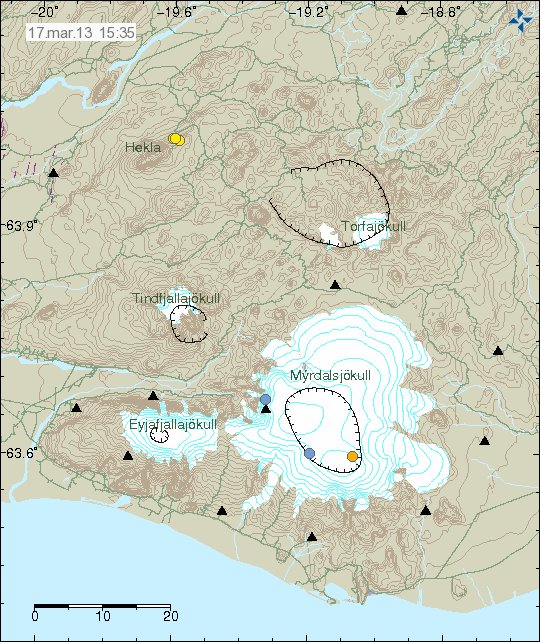
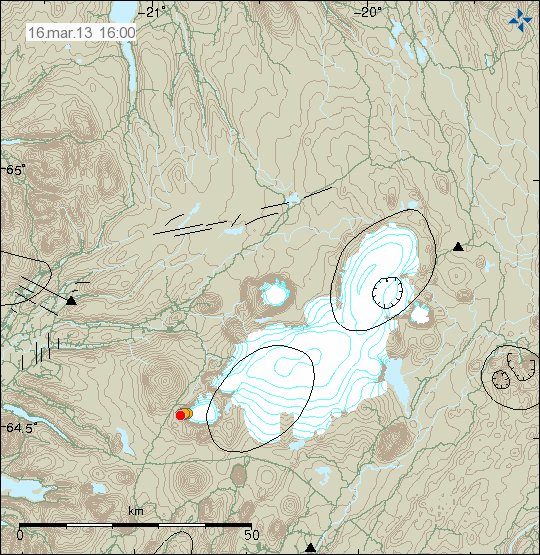
There is a interesting earthquake activity taking place in south part of Katla volcano south caldera rim. This activity has been ongoing since in July 2011 after the minor eruption that year. The most logical reason for this earthquake activity is that in this location is a magma dike on the move. If that is actually the case is impossible to know for now. But this activity remains interesting for many reasons.

130302_1905
Earthquake activity in south Katla volcano caldera rim. This earthquakes are all small earthquakes. Copyright of this image belongs to Icelandic Meteorological Office.

This earthquakes are small. Most of them are on the magnitude range of 0.0 to 0.5. There depth is around 1 km up to 0.1 km (around 100 meters). So whatever is creating this earthquake activity is already shallow up in the crust. I do not know if there is going to be a eruption in this area. That is just a wait and see as always with volcanoes. But it is my estimate that (based on older data) this might mean there is more activity going to take place in Katla volcano soon. But that might fail. Since volcanoes are by nature unpredictable. So there are no assurances about what is going to happen next in Katla volcano.

Earthquake swarm east of Grímsey (TFZ) and in Grímsfjall volcano fissure swarm

Currently there is a minor earthquake swarm east of Grímsey Island in the Tjörnes Fracture Zone. So far the largest earthquake has had the magnitude of 2.9 according to Icelandic Meteorological Office reviewed earthquake overview. Earthquake swarms are common in this area of TFZ.

130228_1930
Earthquake activity in TFZ today. Copyright of this image belongs to Icelandic Meteorological Office.

Grímsfjall and Hamarinn volcanoes

Some internesting earthquake activity is now taking place in Grímsfjall volcano (outside the main volcano). This earthquake activity is in the fissure swarm that extents away from Grímsfjall volcano in the direction of Katla volcano fissure swarm. There has also been interesting earthquake activity taking place in Hamarinn volcano (no GVP page). But Hamarinn volcano last had a minor eruption in July of the year 2011. So far nothing suggests anything of volcanic nature is about to take place.

130228_1930
Earthquake activity in Grímsfjall volcano system today. Along with earthquake activity in Hamarinn volcano. Copyright of this image belongs to Icelandic Meteorological Office.

At the moment it appears that nothing besides earthquakes is going to take place in Grímsfjall volcano. But it hard to be sure given how often Grímsfjall volcano erupts. I do not yet have enough data on what is happening in Hamarinn volcano to say what is taking place there. So for now. It must just be observed.

All quiet in Iceland for the moment

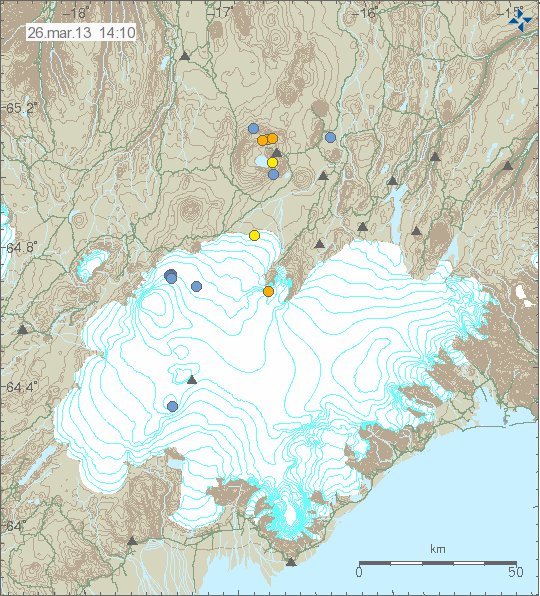
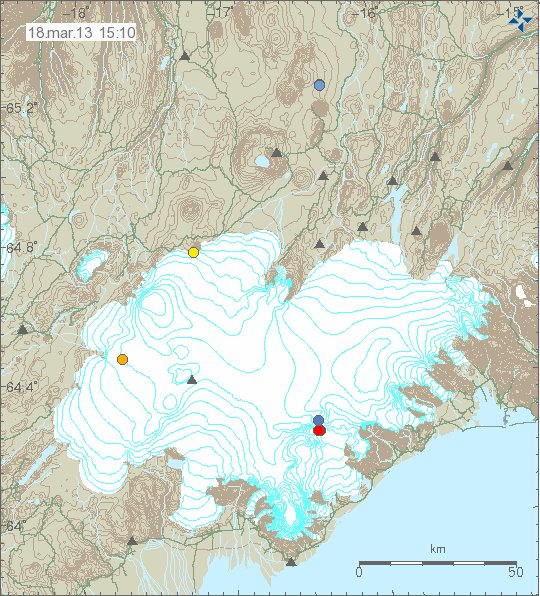
It seems that current quiet period in Iceland continues. So far there has not been a lot of earthquake activity during this week or last week. This is how it has been in Iceland for several weeks now. When it is going to change I do not know yet. But one day the quiet period is going to end.

130223_1145
All quiet in Iceland. Copyright of this image belongs to Icelandic Meteorological Office.

This current lack of activity leaves me with little to write about at the moment. But I am going to try and write about something else while it is quiet like this in Iceland.

Earthquake swarm in Torfajökull volcano

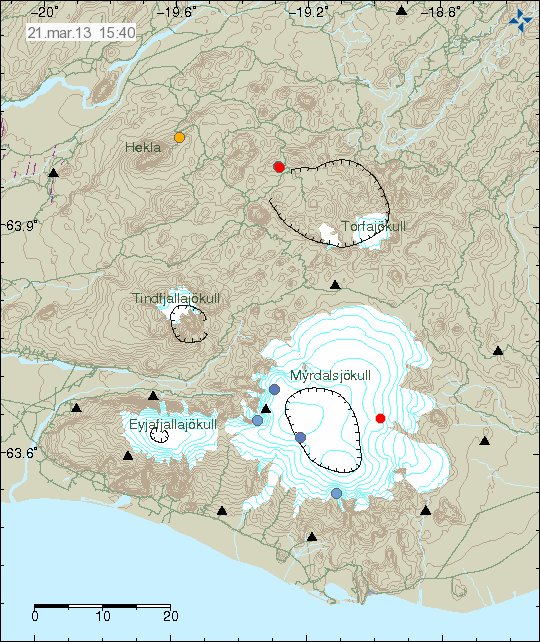
Today (16.02.2013) at 15:11 UTC an earthquake swarm started in Torfajökull volcano. This is so far small earthquake swarm. With largest earthquake only having magnitude 2.6 (automatic result). Depth of this earthquake swarm is around 2 to 4 km. This earthquake swarm is taking place inside the volcano. So they might be magma related. But it is hard to know that for sure at the moment. This might just be normal tectonic earthquakes in this area. Earthquakes are common in this volcano. But major swarm activity does not seem to be for some reason.

130216_1710
Earthquake activity in Torfajökull volcano. The earthquakes are the red dots on this image. Copyright of this image belongs to Icelandic Meteorological Office.

It is hard to know exactly what happens next. But most often the earthquake activity in Torfajökull volcano stops after few hours. Last documented eruption in Torfajökull volcano took place in the year 1477 according to Global volcanism program (GVP). This earthquake activity appears clearly on my Heklubyggð geophone and Skeiðflöt geophone. The web site for my webicorders can be found here.

Just 700 earthquakes recorded in January 2013

According to Icelandic Meteorological Office. Just 700 earthquakes where recorded in January 2013. This is the least active month in Iceland since March 2012. This lack of earthquake activity has meant that I have not had a lot to write about on this blog here.

It is impossible to know if the quiet time is going to continue. But so far of February 2013 this has been the case. But I am sure when the activity picks up in Iceland it is going to pick up in a way that it is going to be noticed.

More about this quiet period in Icelandic

Minni virkni en undanfarna mánuði (mbl.is)
Jarðskjálftar í janúar 2013 (vedur.is)

Minor earthquake swarm on Reykjanes Ridge

A minor earthquake swarm started on Reykjanes Ridge today. So far no earthquake has had the magnitude 3.0 or larger. The largest earthquake so far has had the magnitude 2.8. The depth of this earthquake swarm is around 4 to 7 km.

130206_1850
The earthquake swarm on the Reykjanes Ridge at 18:50 UTC. Copyright of this image belongs to Icelandic Meteorological Office.

It is hard to know what happens with this earthquake swarm. But if any major changes happens with this earthquake swarm. I am going to post a blog post about it soon as possible.

Interesting earthquakes close to Tungafellsjökull volcano

There is some interesting earthquake activity taking place close to Tungnafellsjökull volcano. This earthquake activity started last year in this area. It is unclear what is happening. But this might just be normal tectonic activity. The earthquakes are on the depth of around 4 km.


Earthquake activity close to Tungafellsjökull. Copyright of this image belongs to Icelandic Meteorological Office.

I am not sure if earthquake activity is going to continue in this area. As earthquake activity is intermittent in this area. The Torfajökull volcano however remains silent. But this activity is interesting. Since this area normally does not have earthquake, since it remains outside the main fault zones. But it is still inside the main rift zone in Iceland.

Magnitude 3.2 earthquake in TFZ

At 04:03 UTC on 29.01.2013 an magnitude 3.2 earthquake did happen at TFZ. This earthquake was not felt according to news on this earthquake. Several aftershocks where detected following this magnitude 3.2 earthquake.


The magnitude 3.2 earthquake in TFZ. Along with aftershocks in the same area. Copyright of this image belongs to Icelandic Meteorological Office.

There is a lot of tension in TFZ. But this earthquake swarm does not mean it is ready to break yet. When that happens is impossible to know at this time. Earthquake detection is difficult in Iceland at the moment due to bad weather and strong winds.